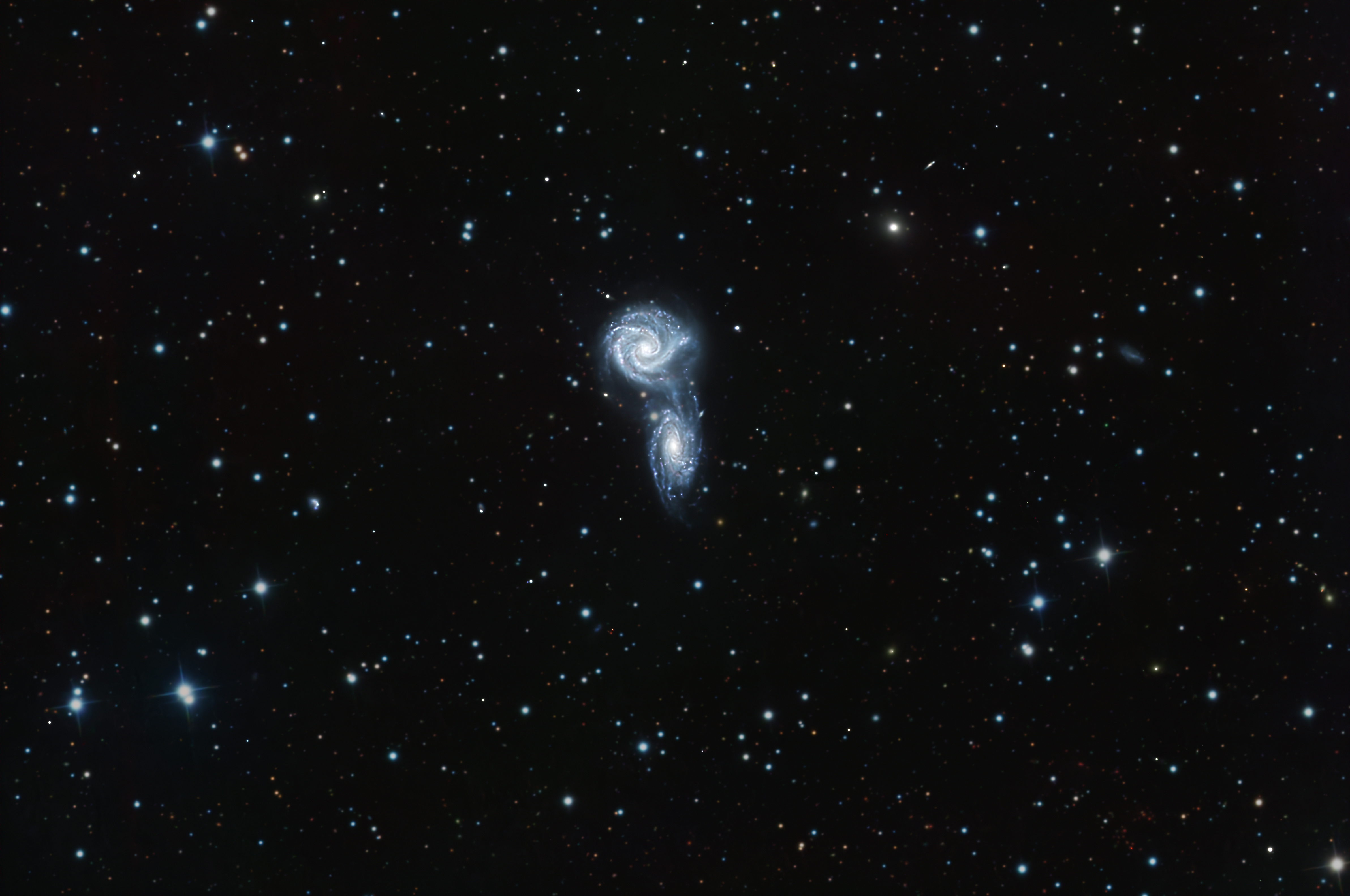
| NGC 5426 This is a pretty cool image of two similarly sizes galaxies that are in the process of interacting, and eventually merging. They are located in the constellation Virgo, and are about 130,000 light-years away from us. You can see that both galaxies have been slightly deformed by their near miss that has left a faint bridge of material connecting them. Image processed by Ron Yelton, original data from Telescope Live |
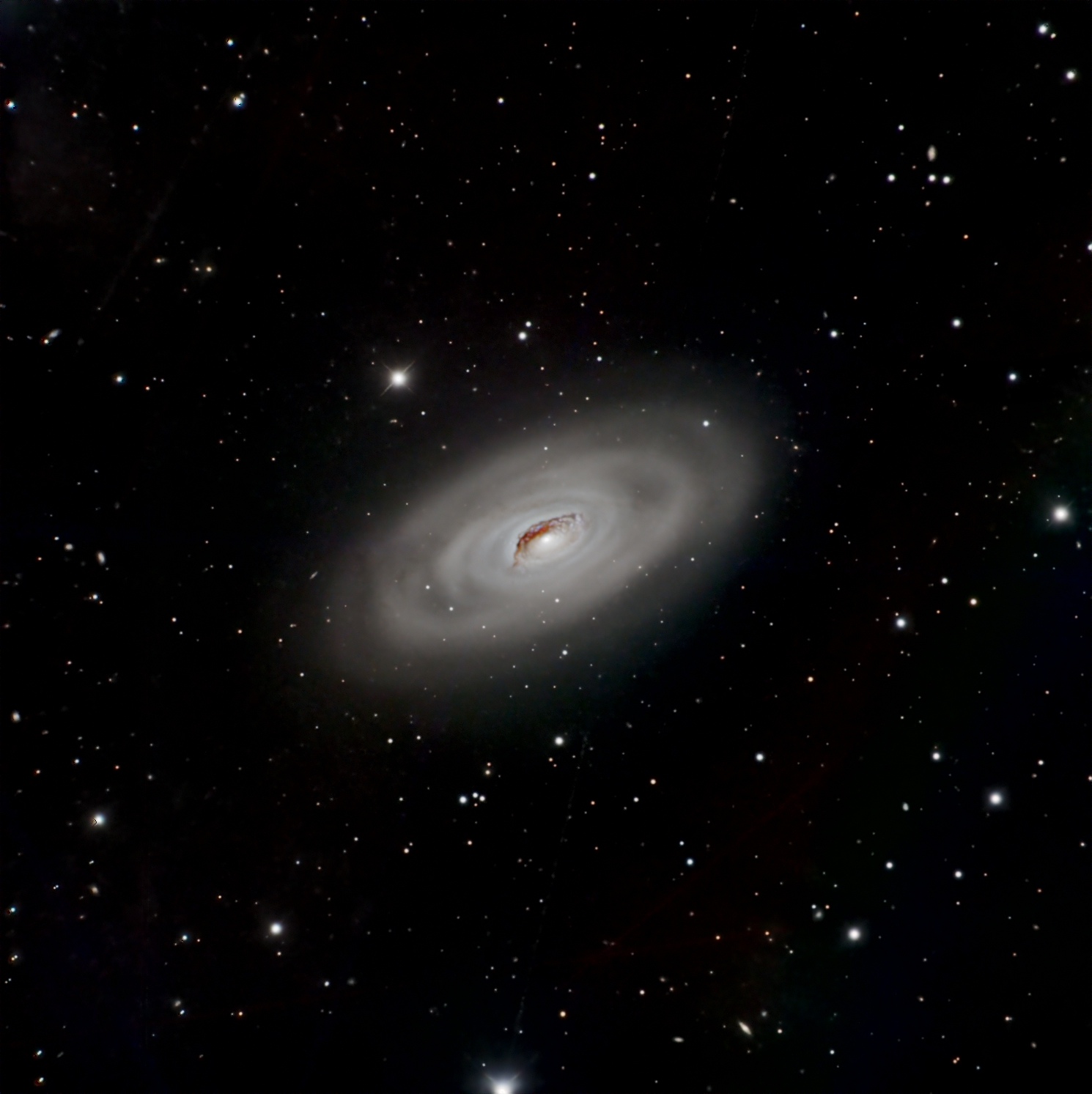
Messier 64
- The Black Eye Galaxy This is a galaxy in the constellation Coma Berenices. It lies about 17 million light-years away. A dark band of dust on one side of the galaxy gives it its name as the Black Eye Galaxy. Image processed by Ron Yelton, original data from Telescope Live |
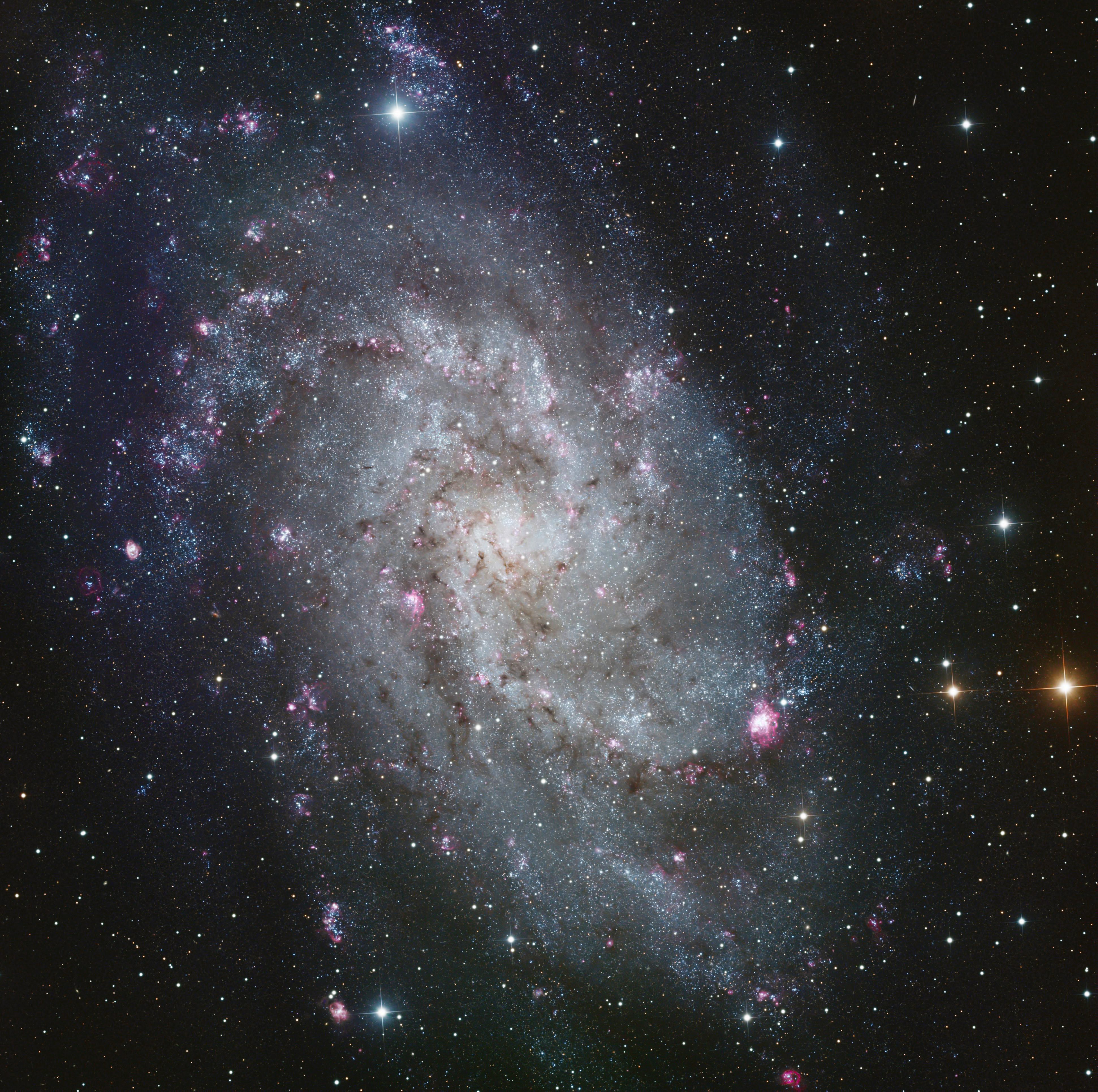
Messier 33
- The Triangulum Galaxy 2.73 million light-years from Earth, in the constellation Triangulum, sits M33. It has a diameter of about 611,100 light-years and is the third largest galaxy in our local group behind Andromeda and the Milky Way. If you zoom in a bit, there are lots of pink, or red areas. These are star-making regions. Image processed by Ron Yelton, original data from Telescope Live |
|
Location: El Sauce Observatory, Chile
Date: May 2025 Mount: Mathis MI-1000/1250 Telescope: Planewave CDK24 (CHI-1) Camera: QHY600m @-25c Exposure: 87 x 5 min for LRGB. Total: 7 hrs 15 min |
Location: IC Astronomy Obs, Spain Date: March 2021 - February 2022 Mount: OS EQ Telescope: Officina Stellare ProRC 700 Camera: FLI PL16803 @ -25C (SPA-2) (CCD) Exposure: LRGB 2 hrs 55 min |
Location: USA
Date: October 2021 Mount: Paramount ME Telescope: Planewave CDK17 (T-17) Camera: FLI Proline PL16803 @-25c Exposure: 93 x 15 min for LRGB. Total: 23 hrs 25 min |
 |
 |
 |
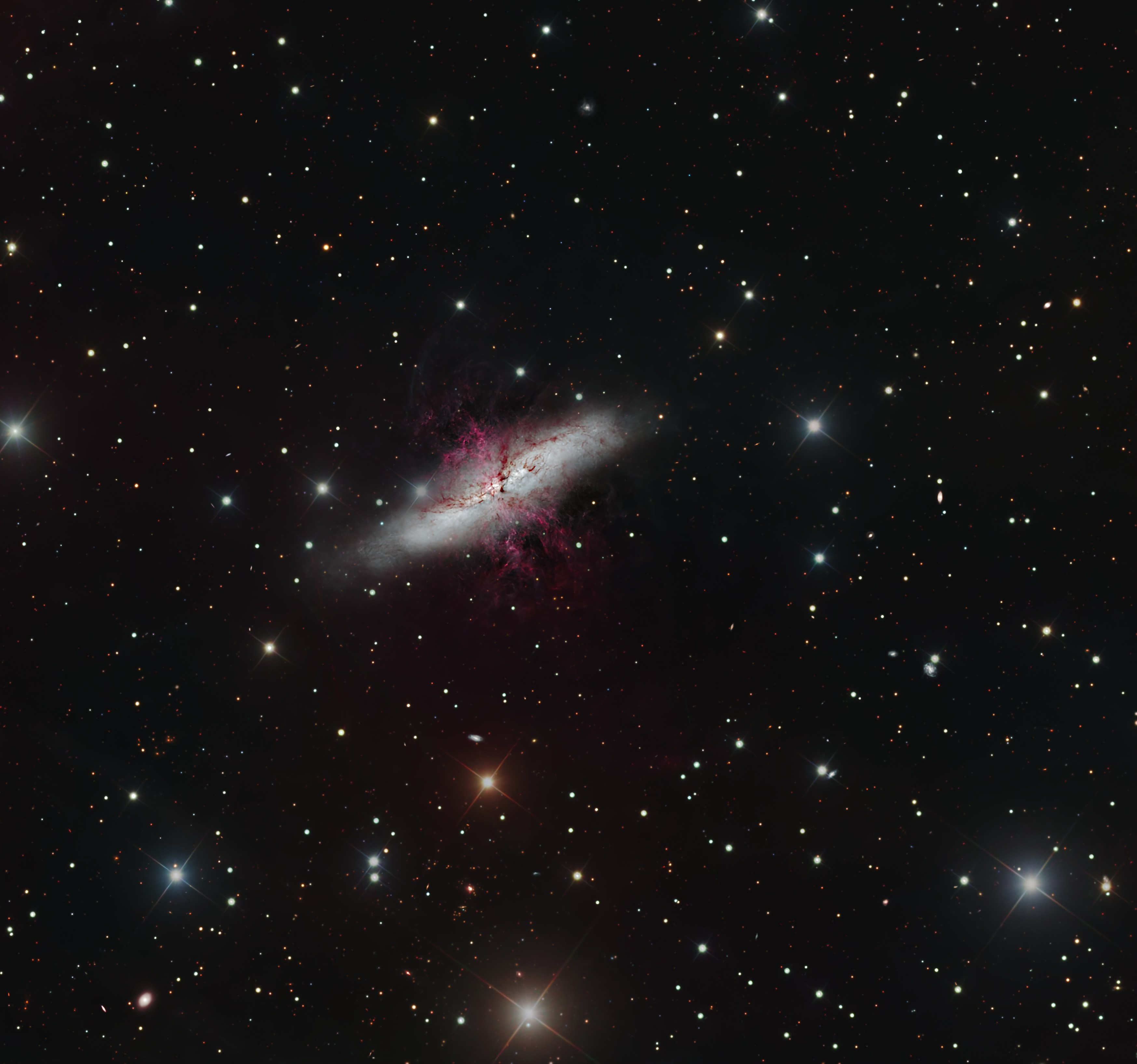
| Messier 82
- The Cigar Galaxy This starburst galaxy is located in the constellation Ursa Major (The Bear). It sits about 12 million light-years away and is the second largest member of the M81 Galaxy Group. Its diameter is about 40,000 light-years. It is about five times more luminous than the Milky Way, and its central region is about one hundred times more luminous. Image processed by Ron Yelton, original data from Telescope Live |
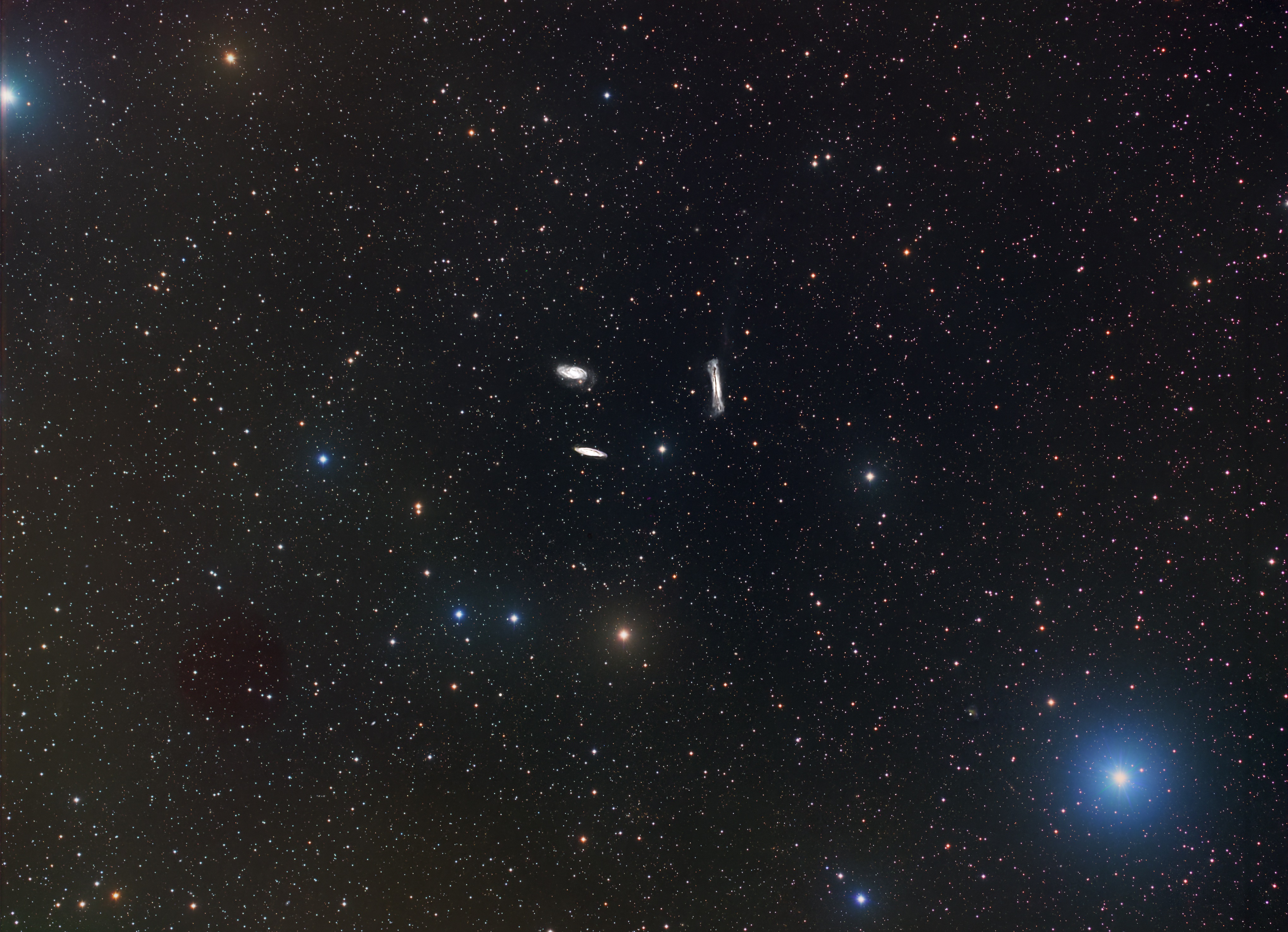
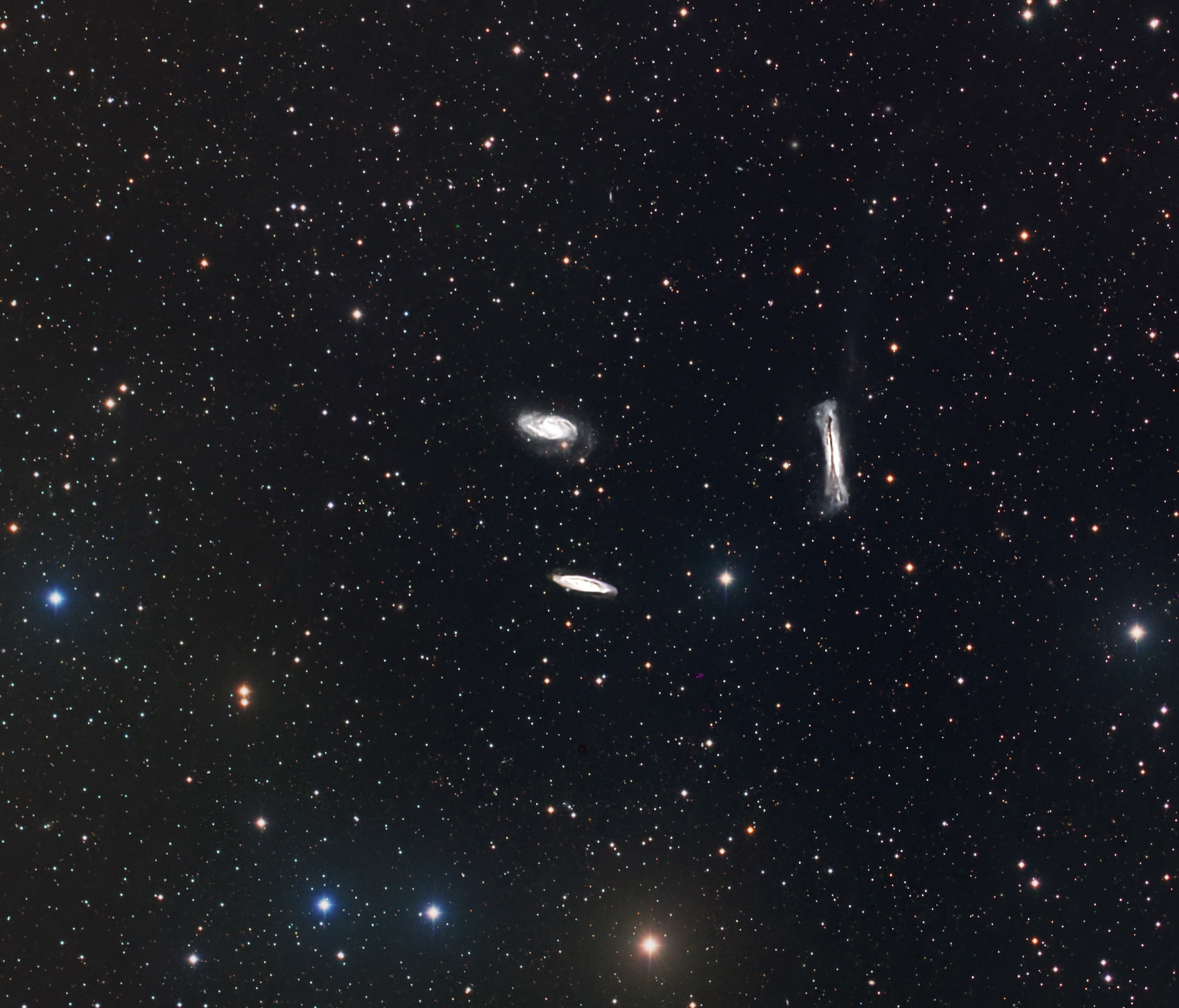
Messier 65 Messier 65 sits in the constellation Leo (The Lion) about 35 million light-years away from us. In this image M65 is the lower-left galaxy. It forms, along with M 66 and NGC 3628, the Leo Triplet. A study from 1978 suggested that all three of these galaxies interacted with each other around 800 million years ago. Although the galaxy itself is low in metals and hydrogen gas, which makes it not prone to new star formation, this previous interaction is probably responsible for its current burst of star formation. Image processed by Ron Yelton, original data from Telescope Live |
Messier 65 This is just a cropped/zoomed-in version of the image to the left. Image processed by Ron Yelton, original data from Telescope Live |
|
Location: USA
Date: October 2021 Mount: Paramount ME Telescope: Planewave CDK17 (T-17) Camera: FLI Proline PL16803 @-25c Exposure: 87 x 15 min for LRGB. Total: 21 hrs 45 min |
Location: IC Astronomy Observatory, Spain
Date: March 2024 Mount: Paramount MX+ Telescope: Takahashi FSQ-106ED (SPA-1) (CCD) Camera:FLI PL16083 @ -25c Exposure: 48 x 5 min LRGB Total: 4 hrs |
Location:
IC Astronomy Observatory, Spain
Date: March 2024 Mount: Paramount MX+ Telescope: Takahashi FSQ-106ED (SPA-1) (CCD) Camera:FLI PL16083 @ -25c Exposure: 48 x 5 min LRGB Total: 4 hrs |
 |
 |
 |
| Messier 63
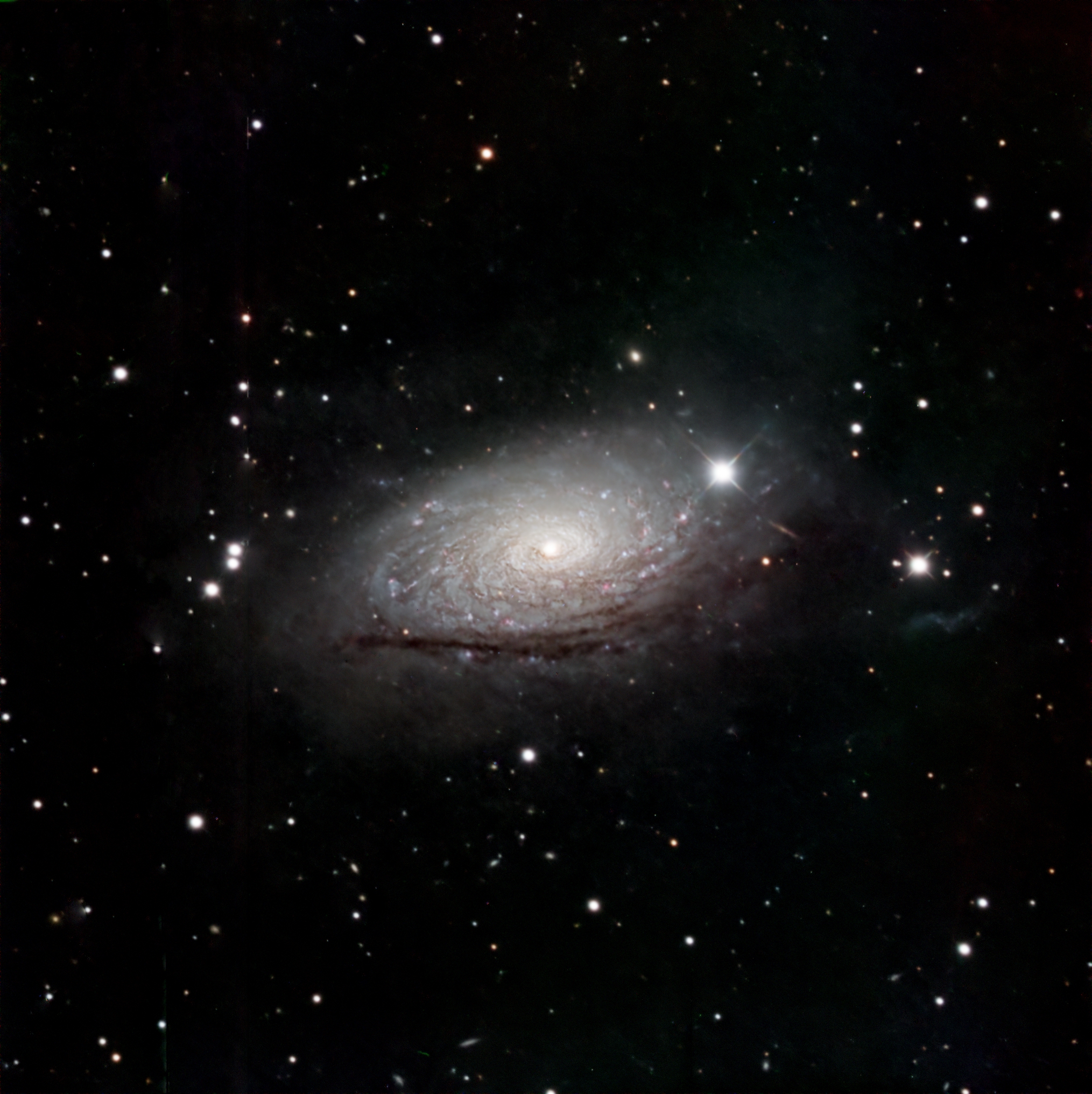
- The Sunflower Galaxy Located in the constellation Canes Venatici, this spiral galaxy sits about 30 million light-years away. It has two spiral arms but no central bar. There is not a lot of star-making activity. Astronomers are fairly certain that it's center has a super-massive black hole, but aren't sure. itf there is one, they figure it would weigh about 850 million sols. Image processed by Ron Yelton, original data from Telescope Live |
Messier 51
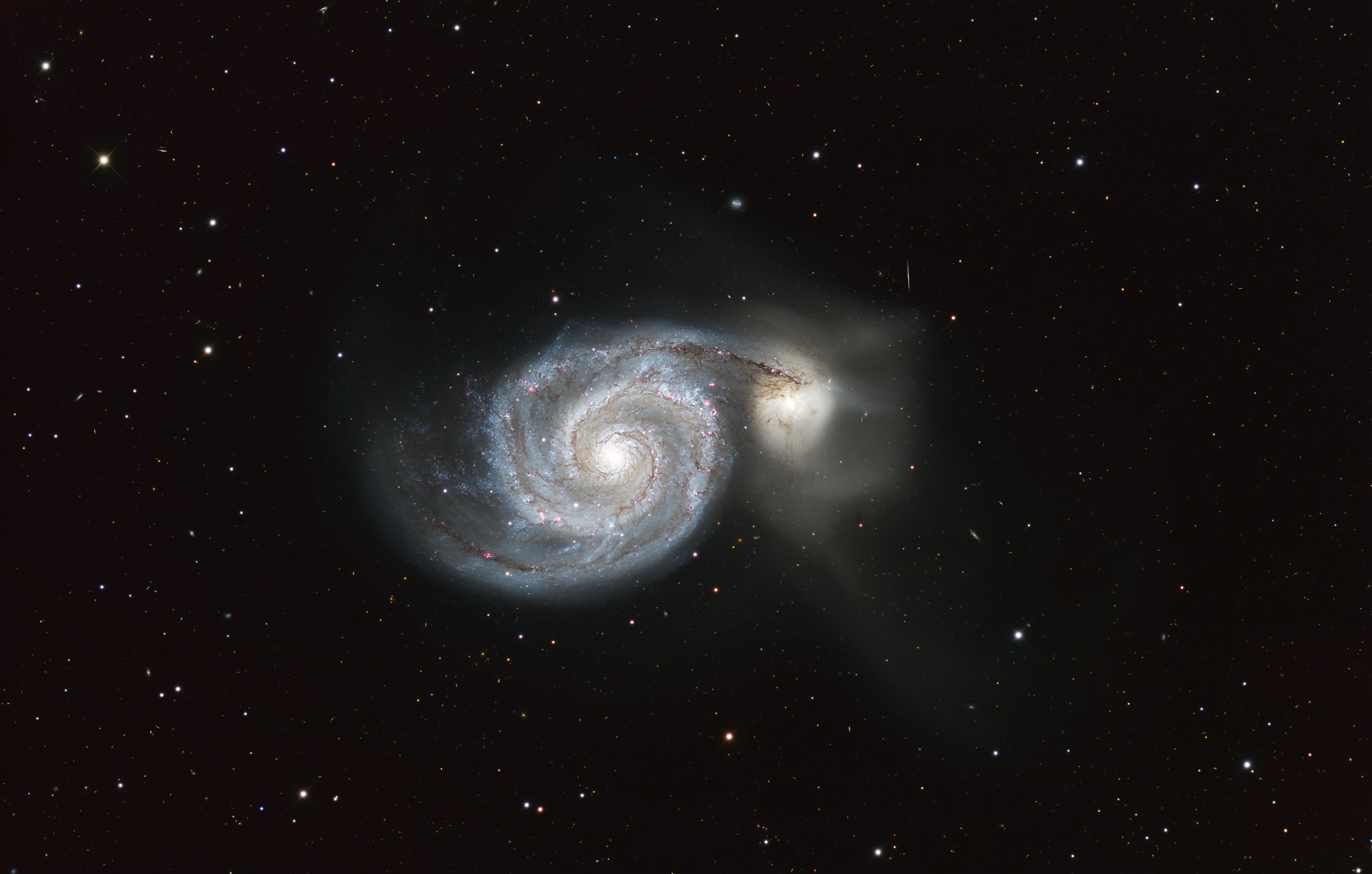
- The Whirlpool Galaxy This galaxy is one of the most imaged objects. It is relatively bright and easy to find in a telescope. It is located in the constellation Canes Vinatici. It's classifies as an interacting grand design spiral galaxy. It sits about 31 million light-years away from us. Its popularity is based on the fact that it, and its companion galaxy, NGC 5195, are are currently locked in an interactive dance. Look closely and you can see that both the outer and inner spiral arms have been gravitationally deformed by a close pass with NGC 5195. Image processed by Ron Yelton, original data from Kieth Allred and Adam Block |
Abell
3571 Located just 654 million light-years away in the galaxy cluster Abell 3571, lies a supergiant eliptical galaxy that goes by the name ESO 383-76. This galaxy is one of the brightest X-ray sources in our sky. The Abell 3571 galaxy cluster is possibly also part of the Shapely Supercluster. The galaxy's diameter is about 1.8 million light-years, making it the largest known galaxy. it also contains a supermassive black hole with an estimated mass of between 2 to 28 billion solar masses. |
|
Location: El Sauce
Observatory, Chile
Date: June 2021 - June 2022 Mount: Officina Stellare EQ Mount Telescope: Officina Stellare ProRC 700 Camera: FLI PL16803 @ -25C (SPA-2) (CCD) Exposure: 151 x 5 min for LRGB 12 hrs 35 min |
Location: USA
Date: May 6, 2021 Mount: ? Telescope: ? Camera: 'SBIG STXL-11002 3 CCD Camera w/ AO' @-25c Exposure: 87 x 5 min for LRGB. Total: 7 hrs 15 min |
Location: El Sauce Observatory, Chile
Date: April 2025 Mount: Mathis MI-1000/1250 Telescope: Planewave CDK24 (CHI-1) Camera: QHY600m @-25c Exposure: 48 x 5 min for LRGB. Total: 4 hrs |
 |
 |
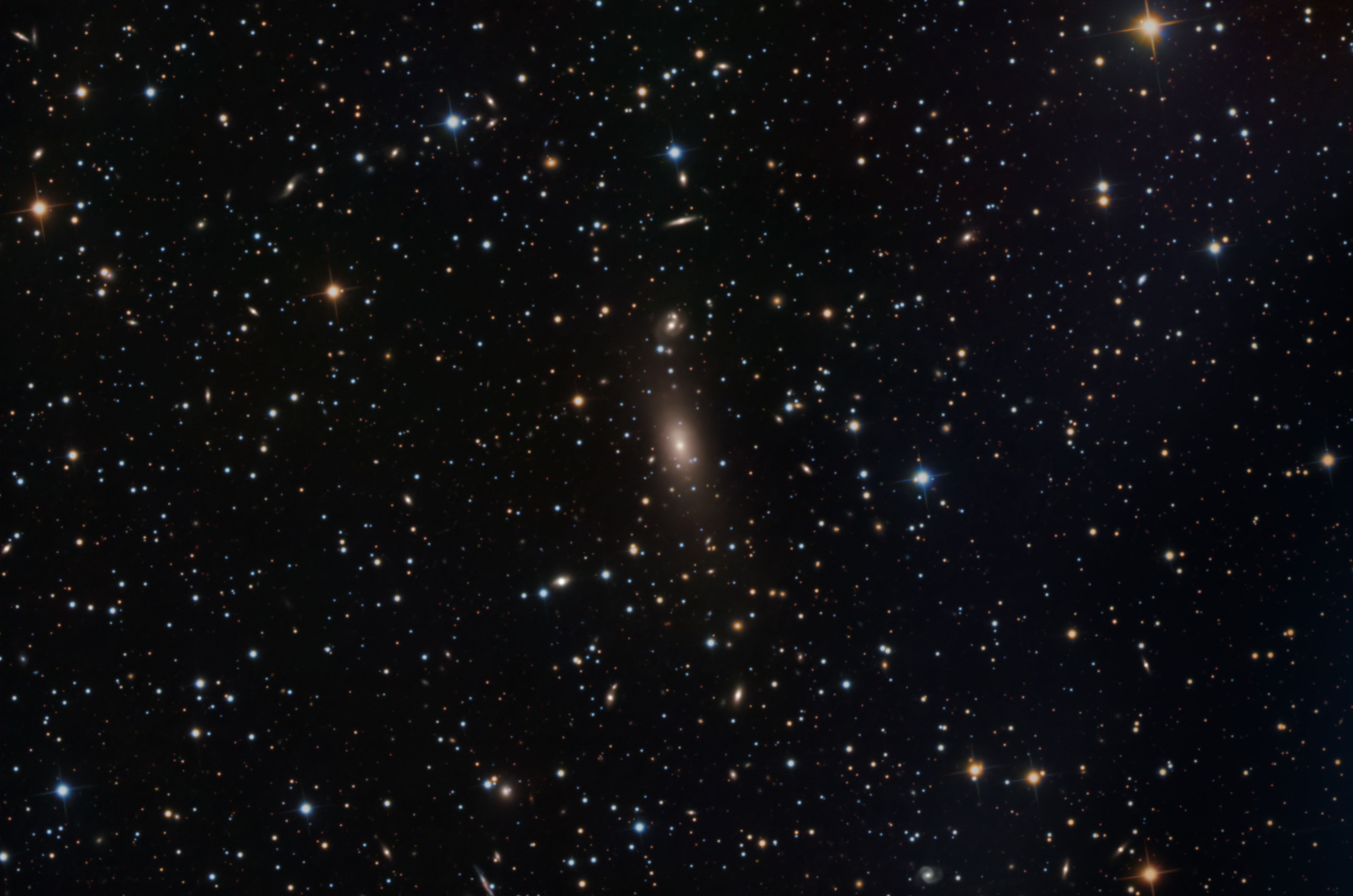 |
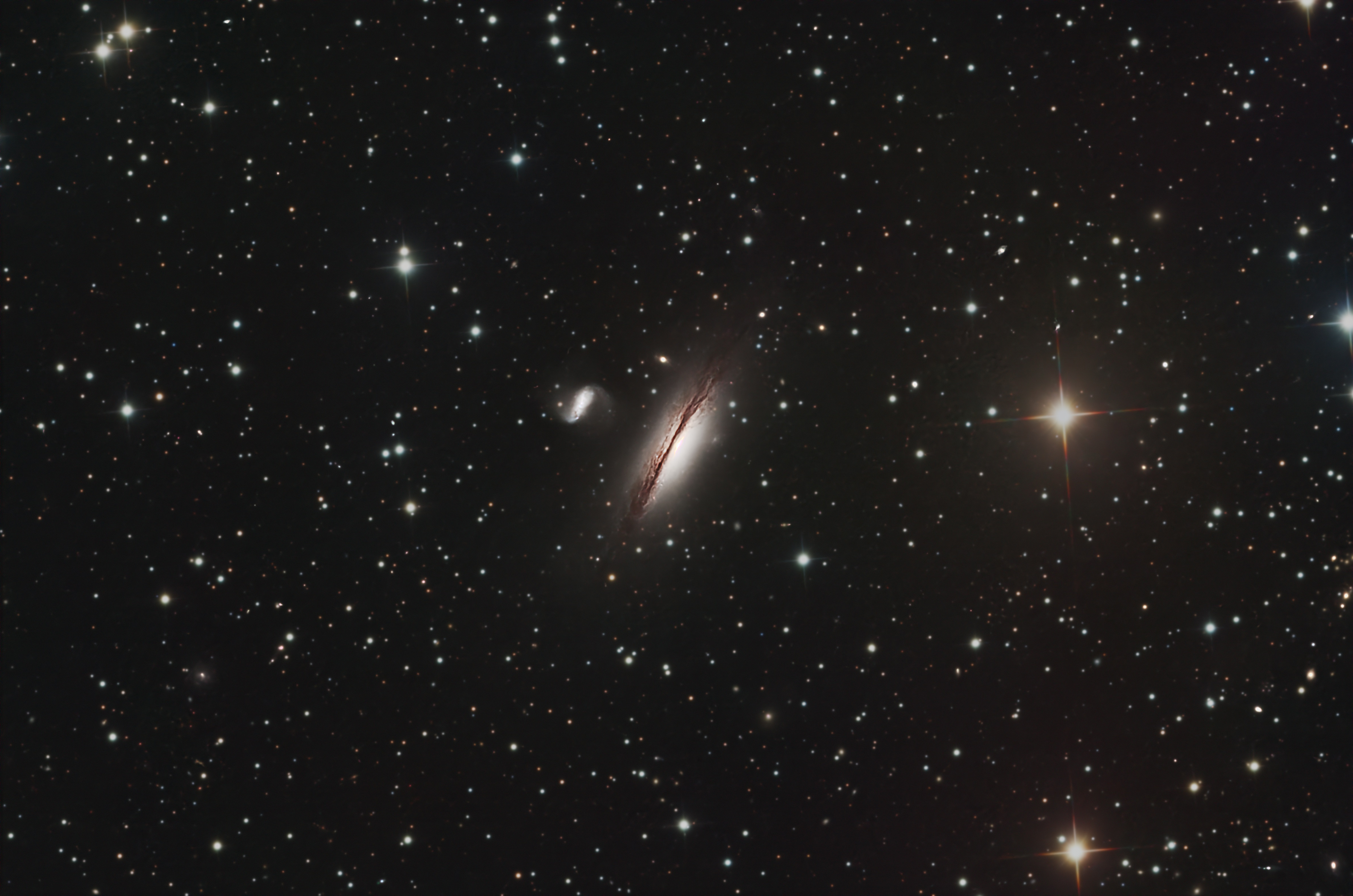
| NGC 5078 NGC 5078 is part of the NGC 5061 Galaxy Group in the constellation Hydra, which contains 10 galaxies. This particular galaxy is a spiral galaxy. It's dust lane appears to have been deformed, probably by an encounter with another nearby galaxy. It sits about 91 million light-years away and has a diameter of 127,000 light-years. Image processed by Ron Yelton, original data from Telescope Live |
Centaurus
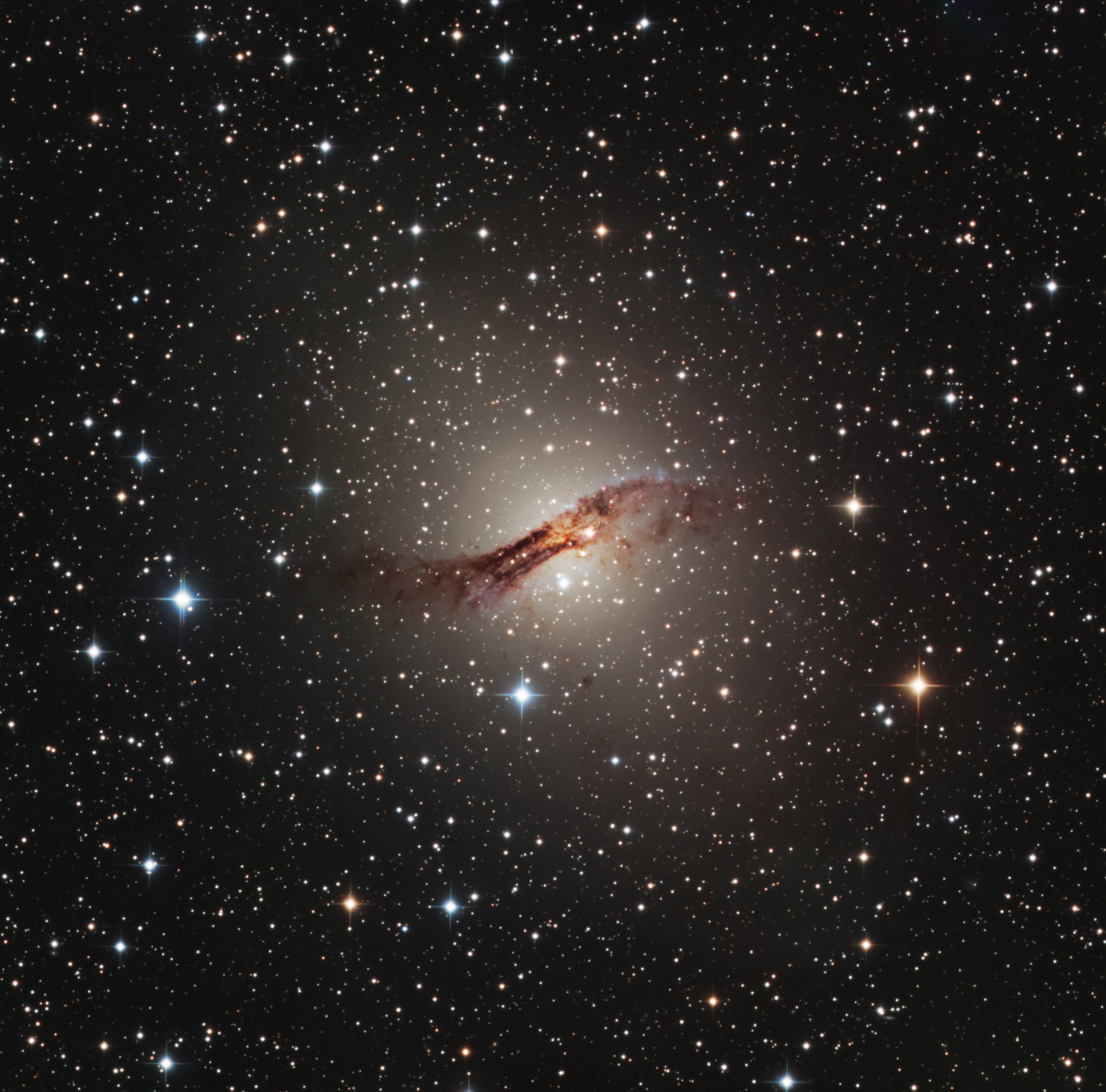
A (Alpha) Also known as NGC 5128, this galaxy lives the constellation Centaurus. It was discovered by the Scottish astronomer James Dunlop from his home in New South Wales back in 1826. Astronomers still cannot decide if it is an elliptical galaxy or a lenticular galaxy. At its center is a supermassive black hole that weighs in at 55 million Sols. It is the 5th brightest object in our night sky, as well as our closest starburst galaxy. Image processed by Ron Yelton, original data from Telescope Live |
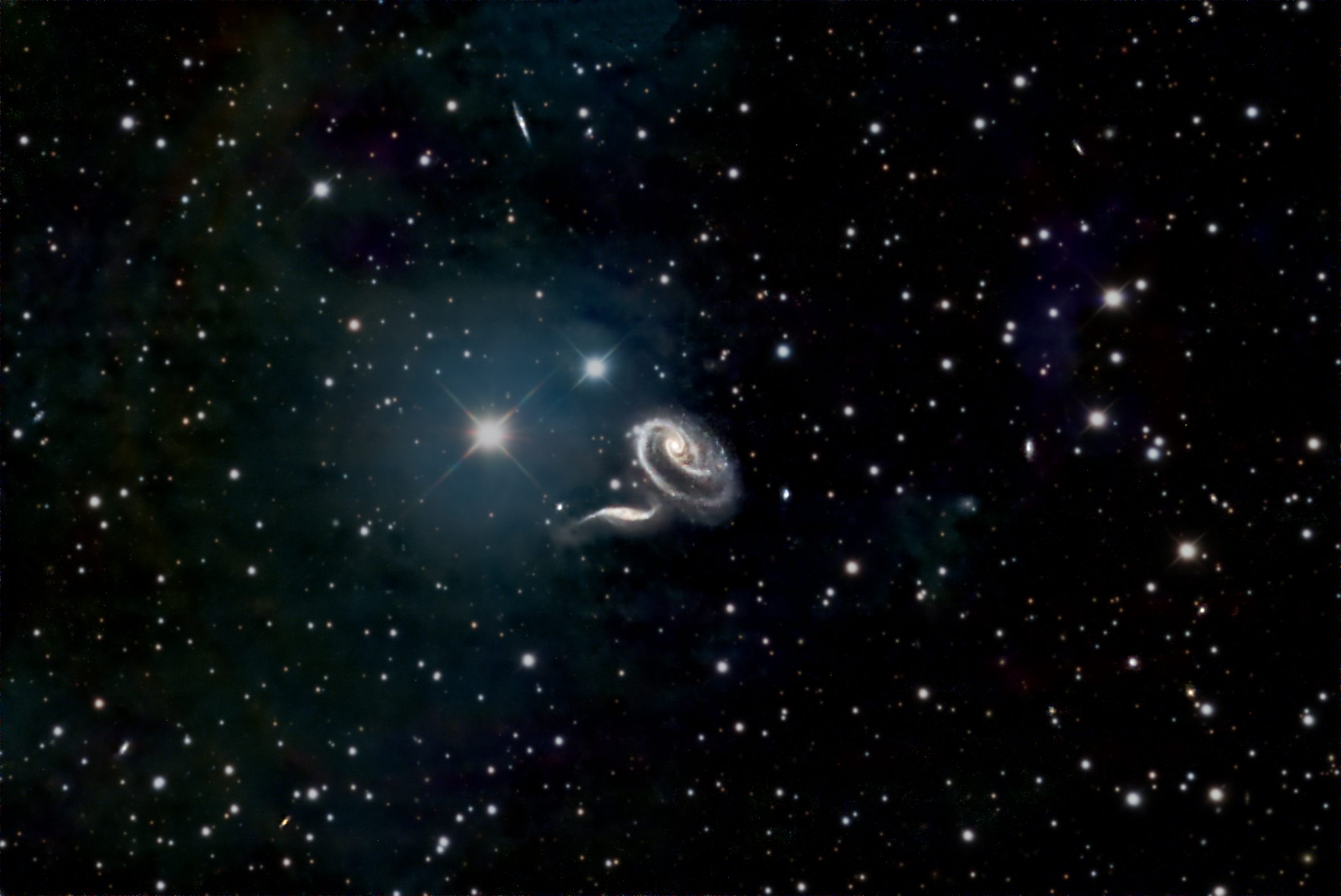
ARP 273 Arp 273 is made up of two interacting galaxies (IAG) in the constellation Andromeda, and is also known as the Rose Galaxies. These two galaxies, due to their gravitational interaction are in the process of eventually merging. Each time they pass each other, getting closer together, they trigger lots of new star formations, turning them both into huge star nurseries. Image processed by Ron Yelton, original data from Telescope Live . |
|
Location: El Sauce Observatory, Chile
Date: July 2023 Mount: Mathis MI-1000/1250 Telescope: Planewave CDK24 (CHI-1) Camera: QHY600m @-25c Exposure: 31 x 5 min for LRGB. Total: 2 hrs 35 min |
Location:
El Sauce Observatory,
Chile
Date: April 2020 Mount: Mathis MI-1000/1250 Telescope: Planewave CDK24 (CHI-1) Camera: FLI PL9000 @ -25c Exposure: 83 x 10 min for LRGB. Total: 13 hrs 50 min |
Location: Heaven's Mirror
Observatory, Australia Date: August 2023 Mount: Paramount MX+ Telescope: FSQ-106ED (AUS-2 CMOS) Camera: QHY600m @ -25c Exposure: 198 x 2 min each for LRGB Total: 3 hr 20 min |
 |
 |
 |
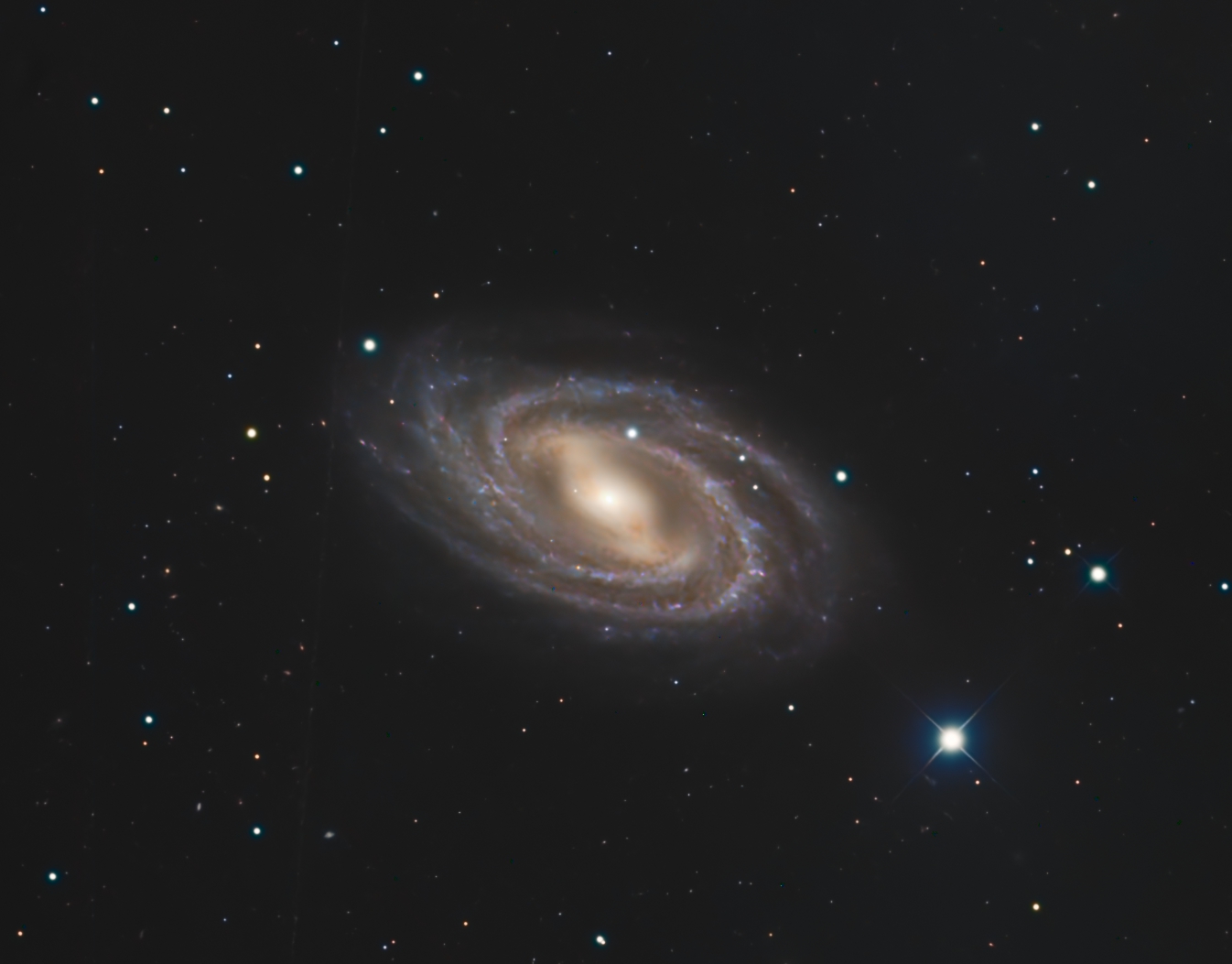
| Messier
109 - The Vacuum Cleaner
Galaxy Messier 109 is a beautiful example of a barred spiral galaxy. Interesting to note that there is an additional ring system just inside the bars. This galaxy sits in Ursa Major (the Bear) and is about 67 million light-years away. It is the largest of the M109 Galaxy Group which has at least 50 other galaxies, In March of 1956, a supernova was observed from the Palomar Observatory. Image processed by Ron Yelton, original data from Telescope Live |
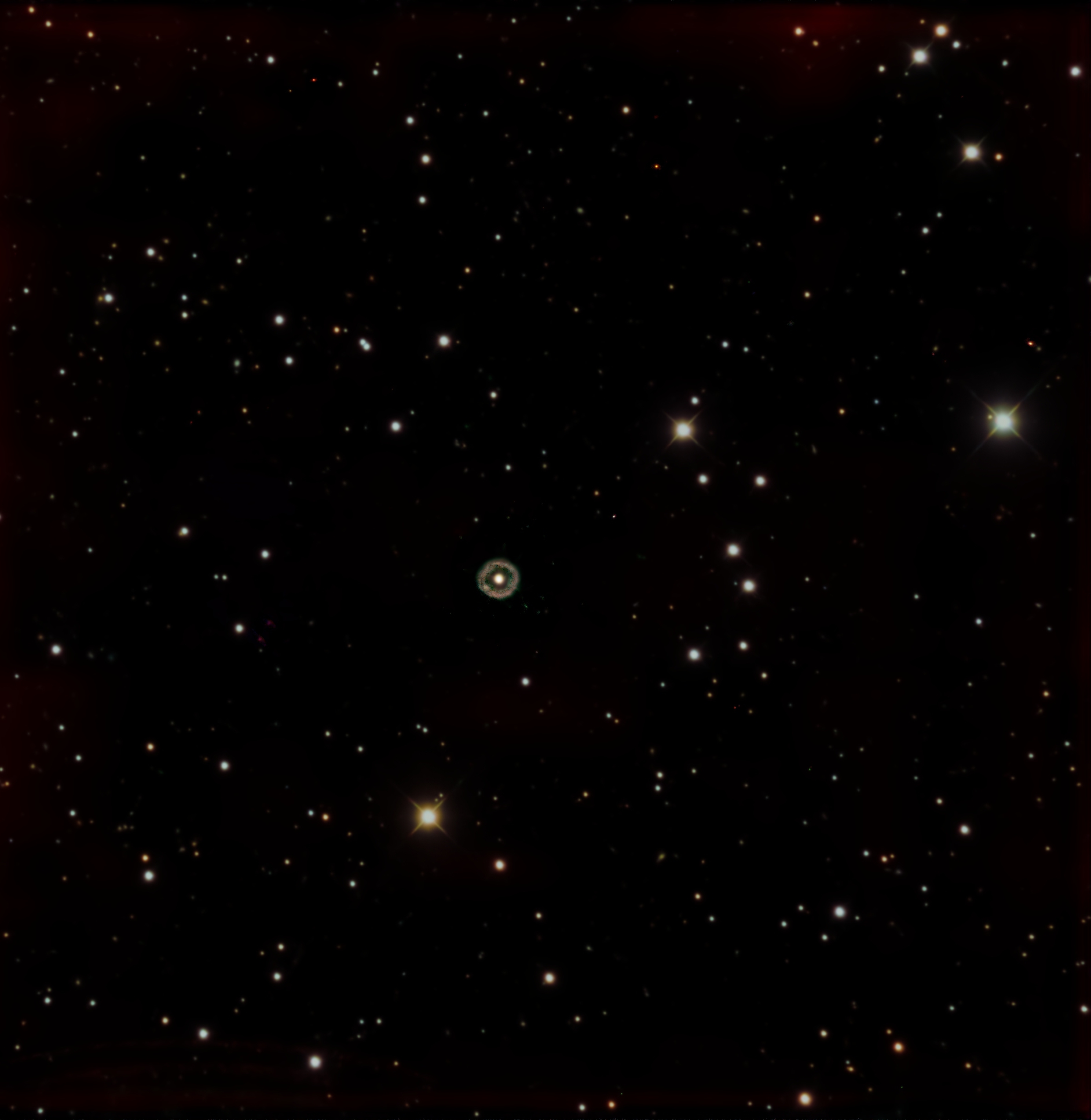
Hoag's Object In the constellation Serpens Caput sits this small, interesting object. Initially, this object was thought to be a planetary nebula due to its similarities to M57 - the Ring Nebula. It turns out that this is actually a very unusual galaxy, called Hoag's Object. It has a near perfect ring of hot, young stars that encircles the central region. The interior diameter of the ring is 148,000 lyrs. It sits about 600 Million lyrs away. Image processed by Ron Yelton, original data from Telescope Live |
Hoag's Object This is the same object as the one to the left - just cropped to zoom in a bit. Image processed by Ron Yelton, original data from Telescope Live |
|
Location:
IC Astronomy Obs, Spain Date: June - July 2021 Mount: OS EQ Telescope: Officina Stellare ProRC 700 Camera: FLI PL16803 @ -25C (SPA-2) (CCD) Exposure: 34 x 5 min LRGB 2 hrs 50 min |
Location: IC Astronomy Obs, Spain Date: July 2020 - June 2021 Mount: OS EQ Telescope: Officina Stellare ProRC 700 Camera: FLI PL16803 @ -25C (SPA-2) (CCD) Exposure: 16 x 10 min LRGB 2 hrs 40 min |
Location: IC
Astronomy Obs, Spain Date: July 2020 - June 2021 Mount: OS EQ Telescope: Officina Stellare ProRC 700 Camera: FLI PL16803 @ -25C (SPA-2) (CCD) Exposure: 16 x 10 min LRGB 2 hrs 40 min |
 |
 |
 |
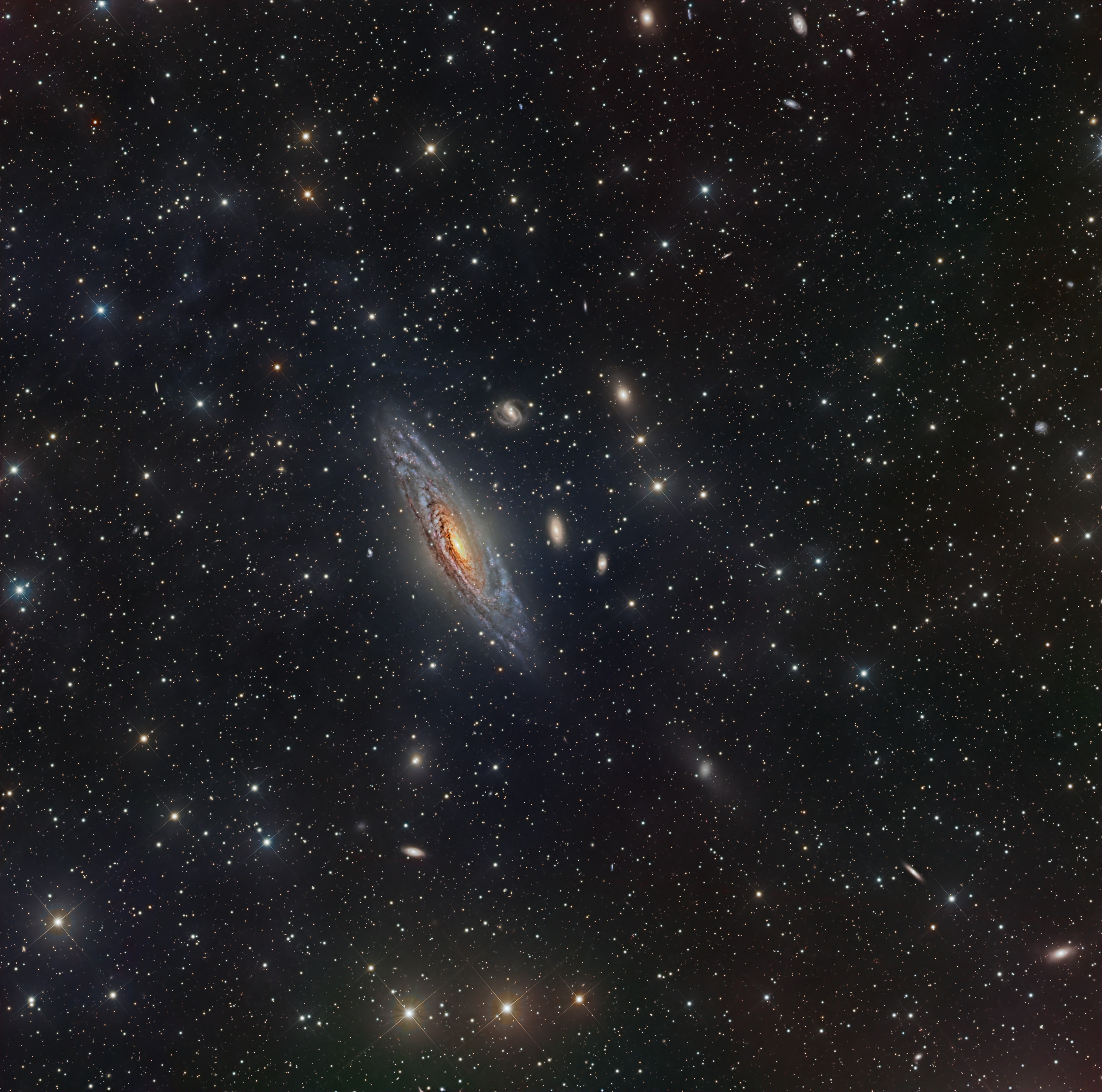
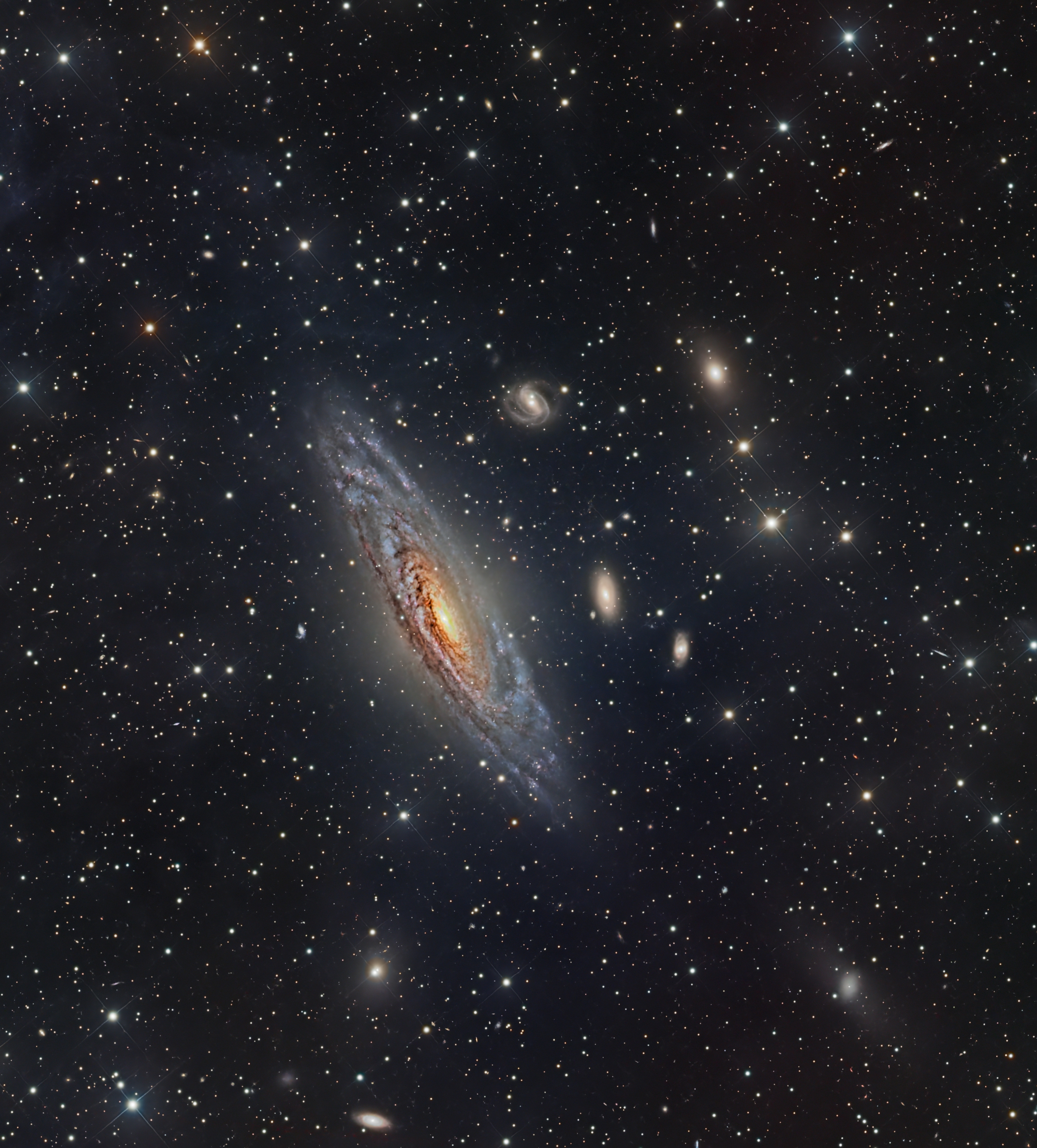
| NGC 7331 NGC 7331 is an unbarred spiral galaxy about 43.79 million light-years away from us in the constellation Pegasus. There is some doubt now about it being unbarred, though. It is commonly referred to as the Milky Way Twin. One distinct difference is that its central bulge, instead of rotating in the same direction as the disk, rotates in the opposite direction. Just in this one image I zoomed in quite a bit and scrolled though the whole image and counted 239 additional galaxies. Image processed by Ron Yelton, original data from Telescope Live |
NGC 7331 This is just a cropped and zoomed-in version of the image to the left. Image processed by Ron Yelton, original data from Telescope Live |
NGC 4038
and 4039 - The Antenna
Galaxies NGC 4039 is the lower of the two galaxies. The upper galaxy is NGC 4038. These two famous interacting galaxies, known as the Antenna Galaxies, are well into the act of merging. Although the stars in each galaxy never collide, the gas and dust inevitably do. This causes massive star formation, and so are known as star-burst galaxies. Discovered by William Herschel in 1785, they reside in the constellation Corvus, about 72 million light-years away. They measure 634,000 x 456,000 light-years. They appear to lie in a bed of red hydrogen gas. Image processed by Ron Yelton, original data from Telescope Live |
|
Location:
USA
Date: September - November 2022 Mount: Paramount ME Telescope: Planewave CDK17 (T-17) Camera: FLI Proline PL16803 @-25c Exposure: 87 x 15 min for HLRGB. Total: 21 hrs 45 min |
Location:
USA
Date: September - November 2022 Mount: Paramount ME Telescope: Planewave CDK17 (T-17) Camera: FLI Proline PL16803 @-25c Exposure: 87 x 15 min for HLRGB. Total: 21 hrs 45 min |
Location: El Sauce Observatory, Chile
Date: April - June 2023 Mount: Mathis MI-1000/1250 Telescope: Planewave CDK24 (CHI-1) Camera: QHY600m @-25c Exposure: 77 x 5 min for HLRGB. Total: 6 hrs 25 min |
 |
 |
 |
| NGC 4038
and 4039 - The Antenna
Galaxies This another view of the preceding image in the row above. In the first image color was calibrated referencing or G2v sun. That gives natural looking color. In this image, color was balanced using a bluer K type star. The differences are subtle, but the galaxies and their tidal trails are a touch bluer. Image processed by Ron Yelton, original data from Telescope Live |
Hickson 61
(HCG 61) - The Box This collection of four galaxies in Coma Berenices, was first discovered by William Herschel in 1785. He originally listed them as a single nebula. In 1981 Paul Hickson presented photo plates that showed that this was, in fact, a galaxies group. According to his criteria, a galaxy group must contain at least for distinct galaxies, reasonably compact and isolated from from any other group. Image processed by Ron Yelton, original data from Telescope Live |
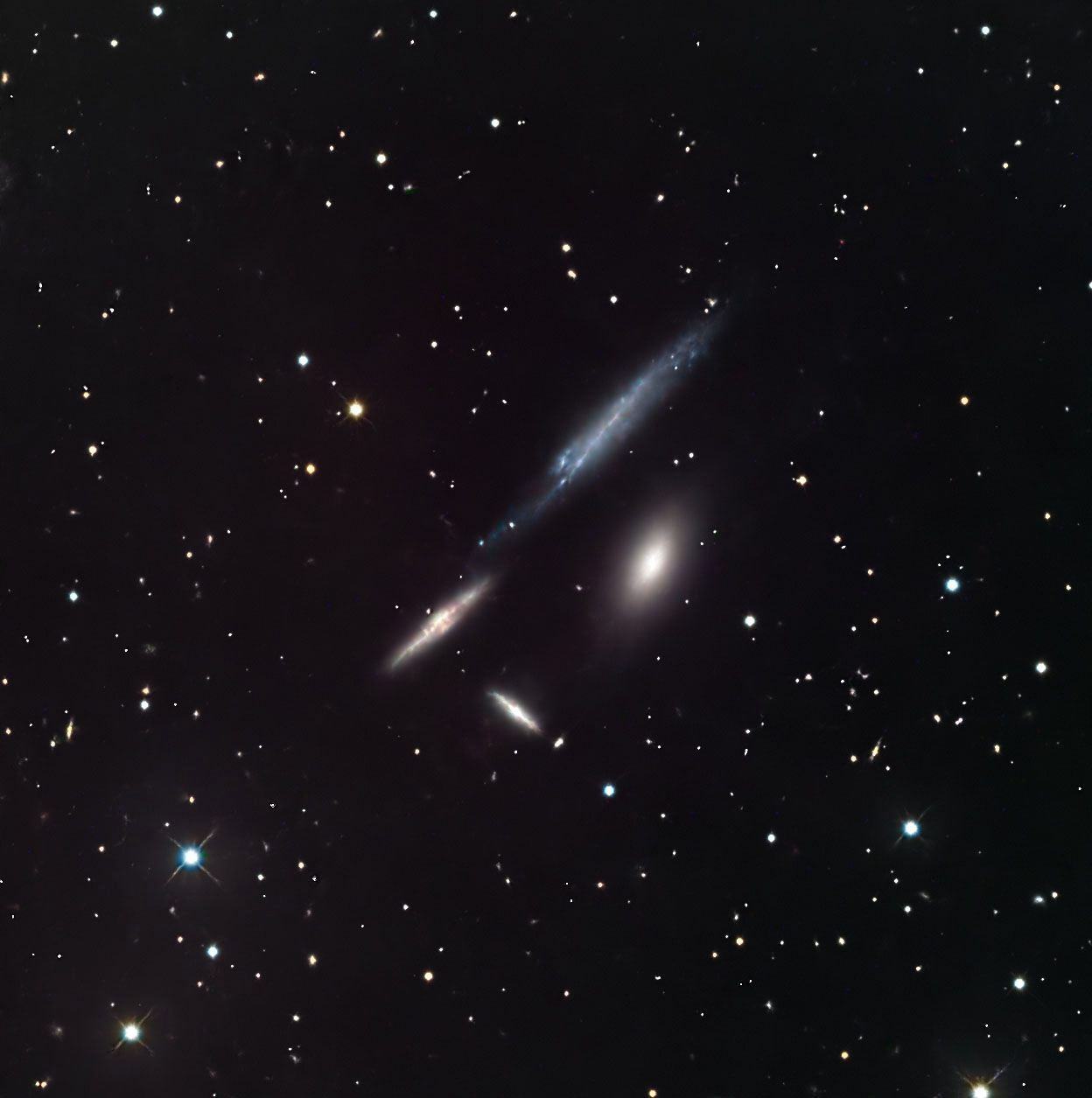
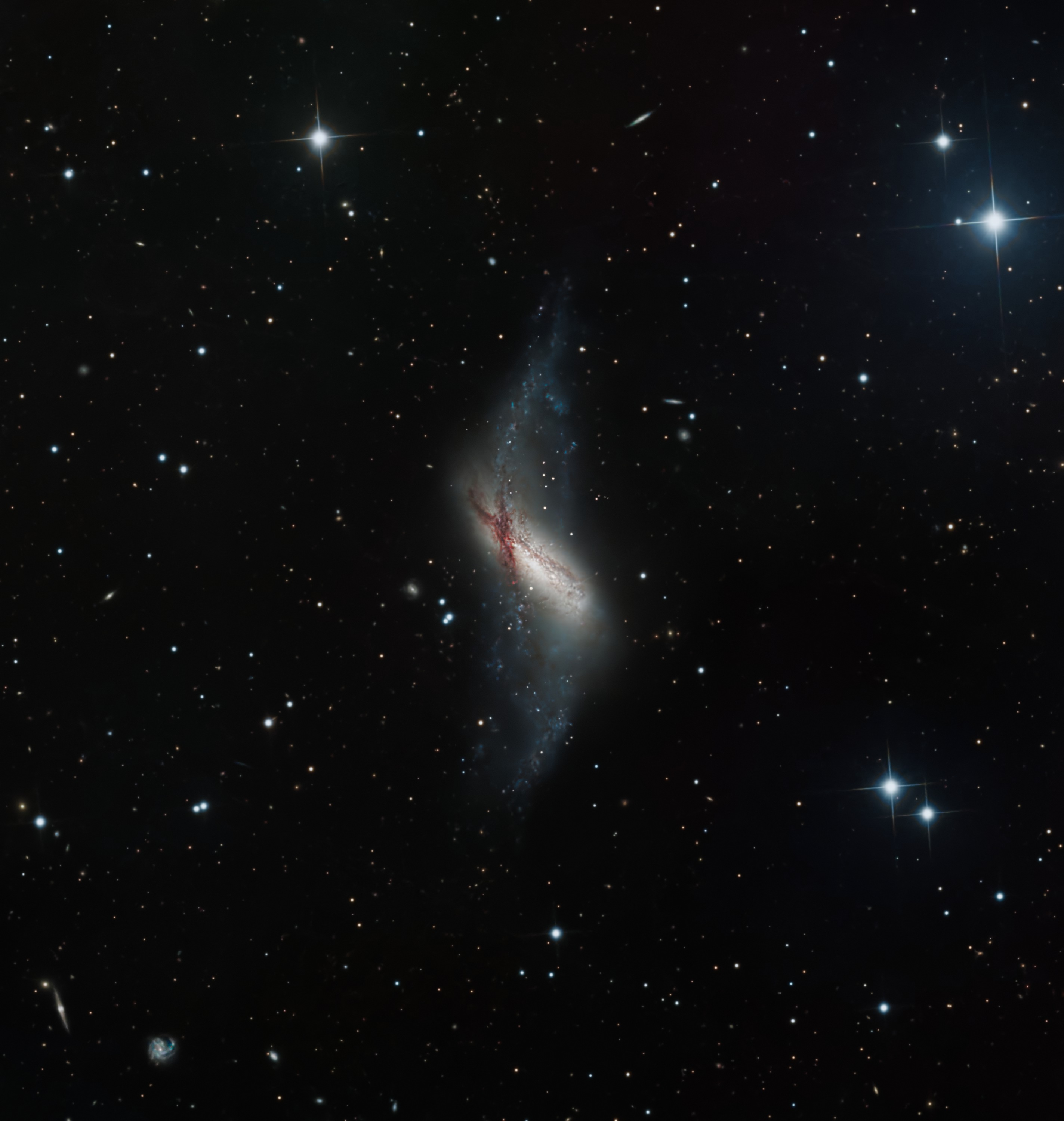
NGC 660 Sitting in the constellation Pisces, is the peculiar polar ring galaxy NGC 660. It lies about 45 million light-years away from us and spans about 45,000 light-years. It is classified as a peculiar galaxy because of its ring of gas, dust and stars that rotates perpendicular to the main disk. Astronomers believe that this was caused by a galactic collision that occurred about a billion years ago. The polar ring consists of, among other types of stars, many red and blue supergiant stars. The youngest of which is only 7 million years old. Image processed by Ron Yelton, original data from Telescope Live |
|
Location: El Sauce Observatory, Chile
Date: April - June 2023 Mount: Mathis MI-1000/1250 Telescope: Planewave CDK24 (CHI-1) Camera: QHY600m @-25c Exposure: 77 x 5 min for HLRGB. Total: 6 hrs 25 min |
Location: IC Astronomy Obs, Spain Date: April 2022 Mount: OS EQ Telescope: Officina Stellare ProRC 700 Camera: FLI PL16803 @ -25C (SPA-2) (CCD) Exposure: 12 x 10 min LRGB 2 hrs |
Location: El Sauce Observatory, Chile
Date: November-December 2023 Mount: Mathis MI-1000/1250 Telescope: Planewave CDK24 (CHI-1) Camera: QHY600m @-25c Exposure: 141 x 10 min for HLRGB. Total: 23 hrs 30 min |
 |
 |
 |
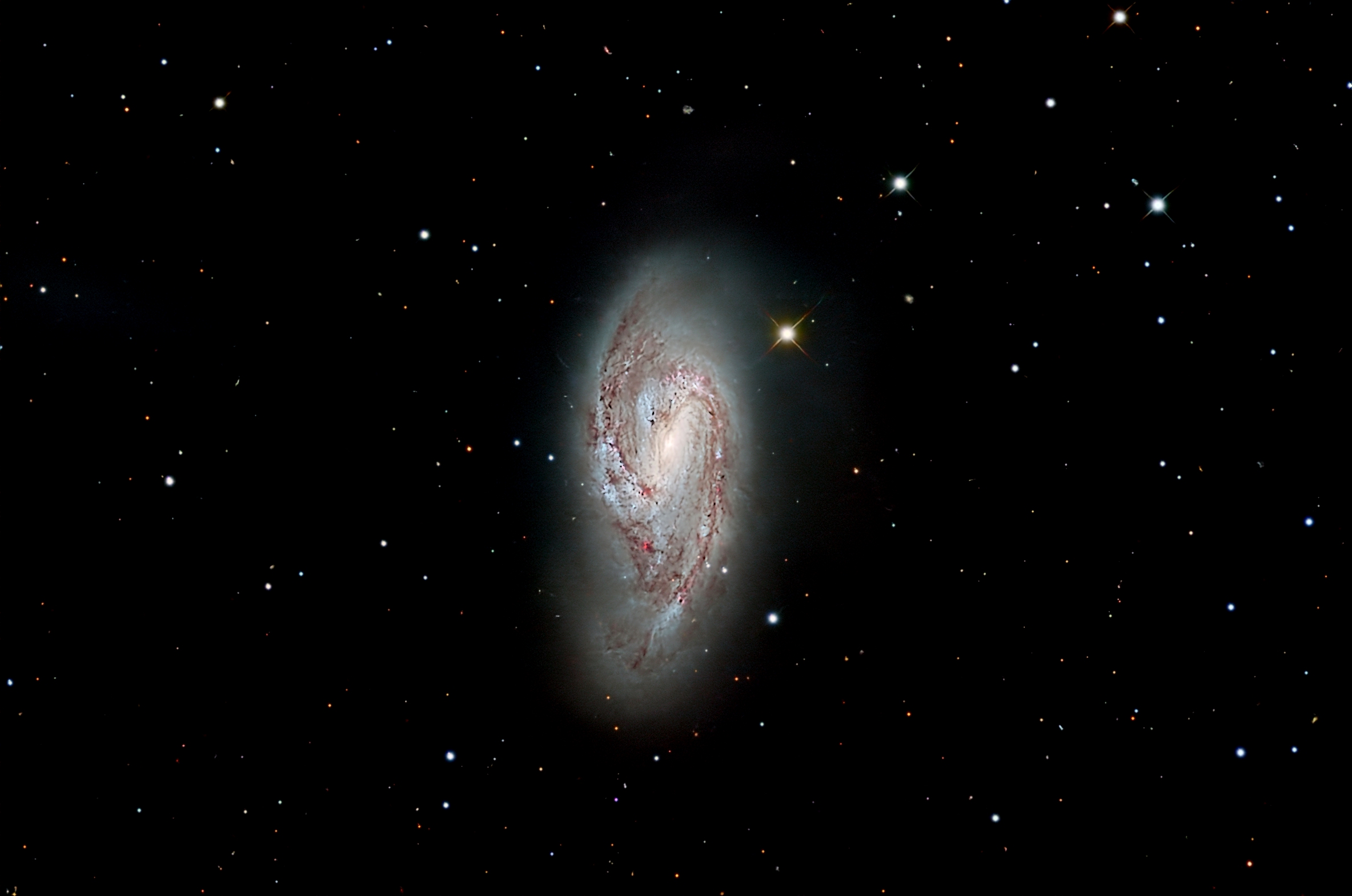
| Messier 66 This Messier object is an intermediate spiral galaxy that sits in the constellation Leo. It lies around 31 million light-years away from us. It is part of the Leo Triplet group of galaxies, that, in addition to M66, include M65 and NGC 3628. It has a diameter of 95,000 light-years. It also has an unusually high rate of star formation in its spiral arms. Image processed by Ron Yelton, original data from Telescope Live |
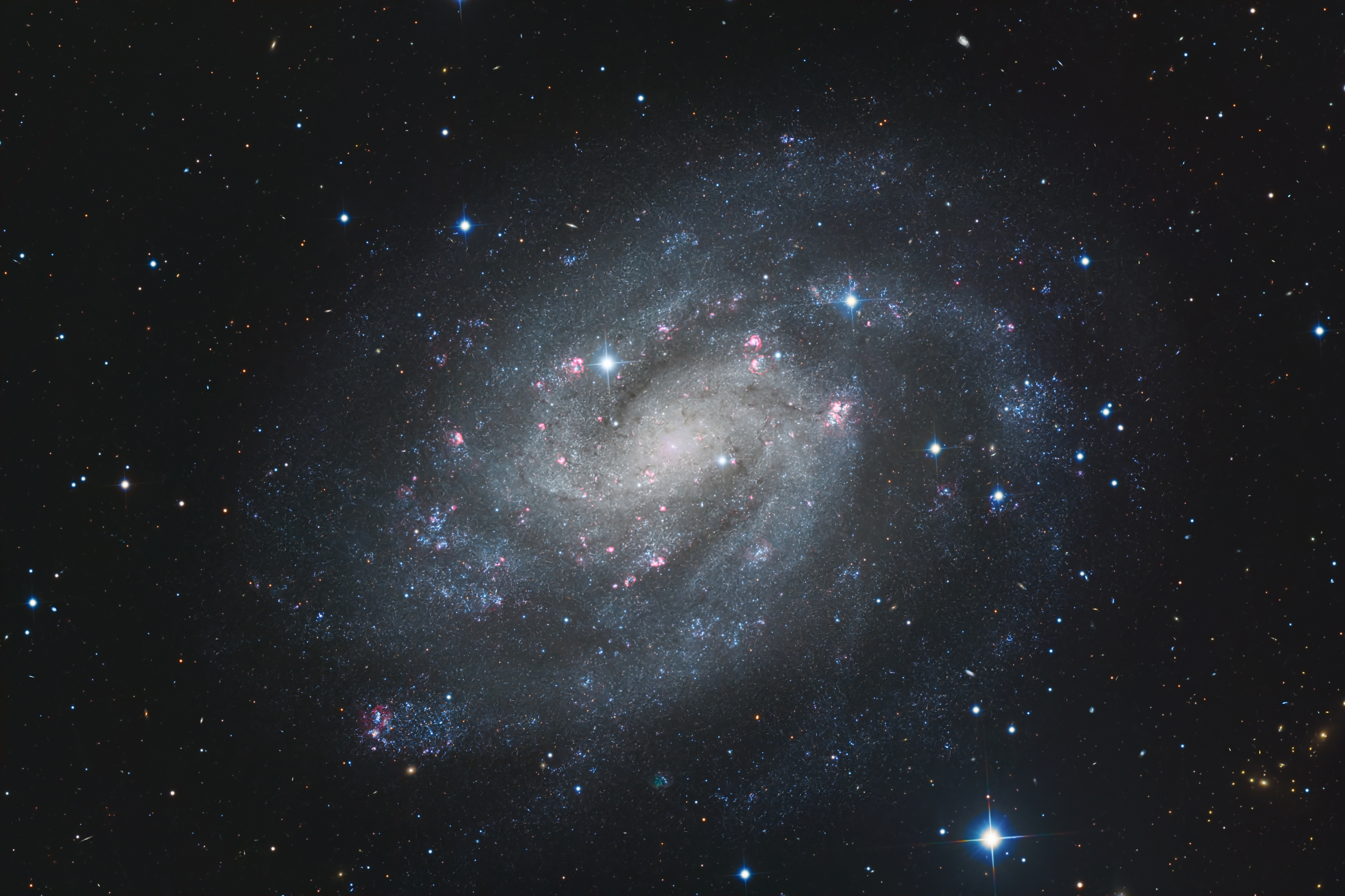
NGC 300 NGC 300, also known as the Sculptor Pinwheel Galaxy, is located in the constellation Sculptor. It is about 94,000 light-years in diameter, which makes it just a little smaller than our Milky Way. It sits about 6 million light-years away from us. It also sits at an inclined angle of about 42 degrees, which gives us great views of its spiral arms, dust lanes and its central core area. It is also one of the brightest galaxies in the Sculptor Galaxy Group. Image processed by Ron Yelton, original data from Telescope Live |
|
Location: IC Astronomy Obs, Spain Date: April 2023 Mount: Officina Stellare Eq Fork Telescope: Officina Stellare ProRC 700 Camera: QHY600m (SPA-2) (CMOS) Exposure: 71 x 120 sec LRGB 2 hrs 20 min |
Location: El Sauce Observatory, Chile
Date: June 2023 - October 2024 Mount: Mathis MI-1000/1250 Telescope: Planewave CDK24 (CHI-1) Camera: QHY600m @-25c Exposure: 156 x 5 min for HLRGB. Total: 14 hrs 40 min |
 |
 |
Except as noted all images Copyright © by Ron Yelton and may not be used without permission.