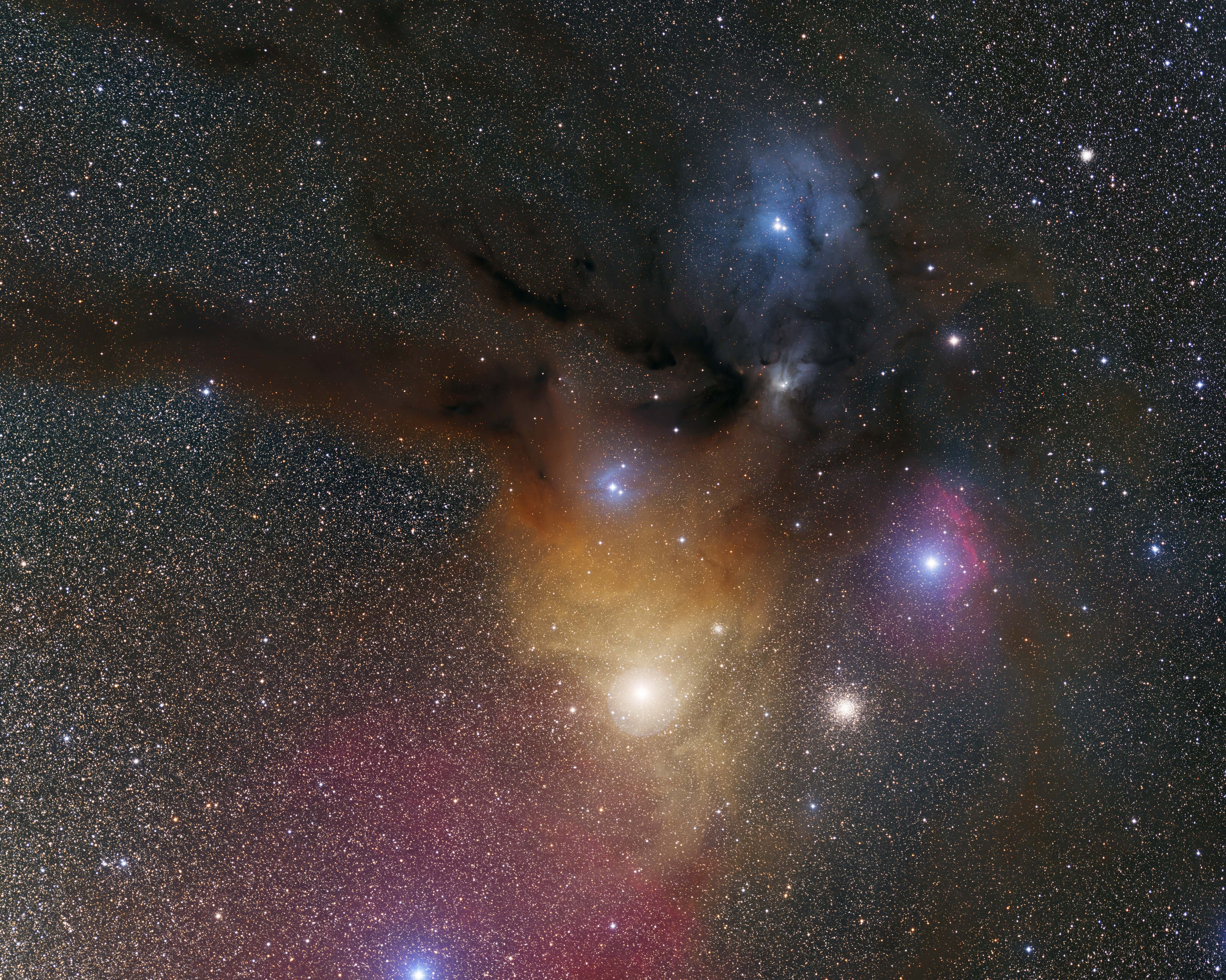
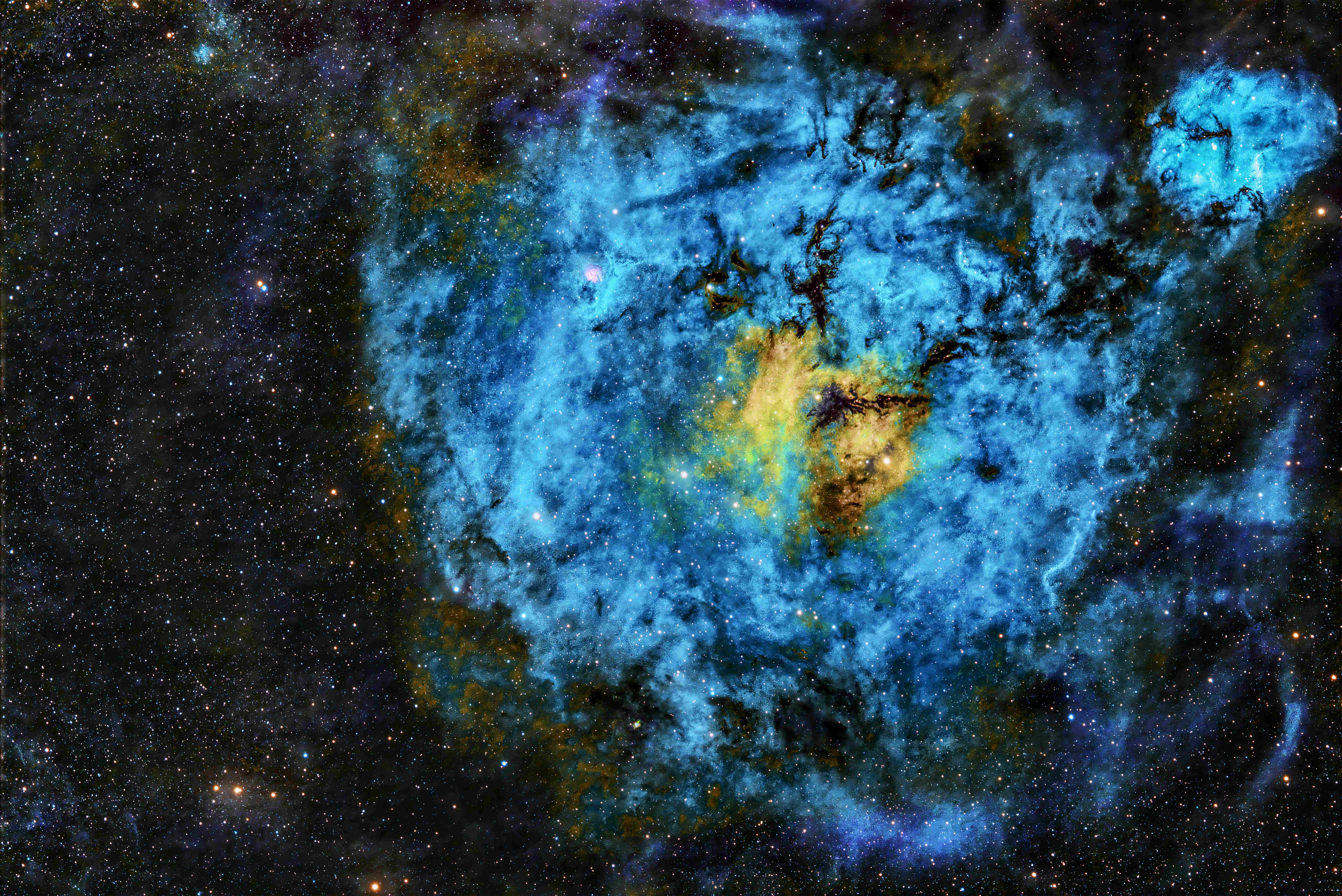
| IC 4605 - The Blue Angel Nebula Inside the Rho Ophiuchi Cloud Complex, in the constellation Scorpius, lies The Blue Angel Nebula. This is a reflection nebula with a very active star forming region embedded in the bright area just below center. The other stars that illuminate their surrounding gasses are brand new, hot stars. The region sits between 400-700 light-years away. Image processed by Ron Yelton, original data from Telescope Live |
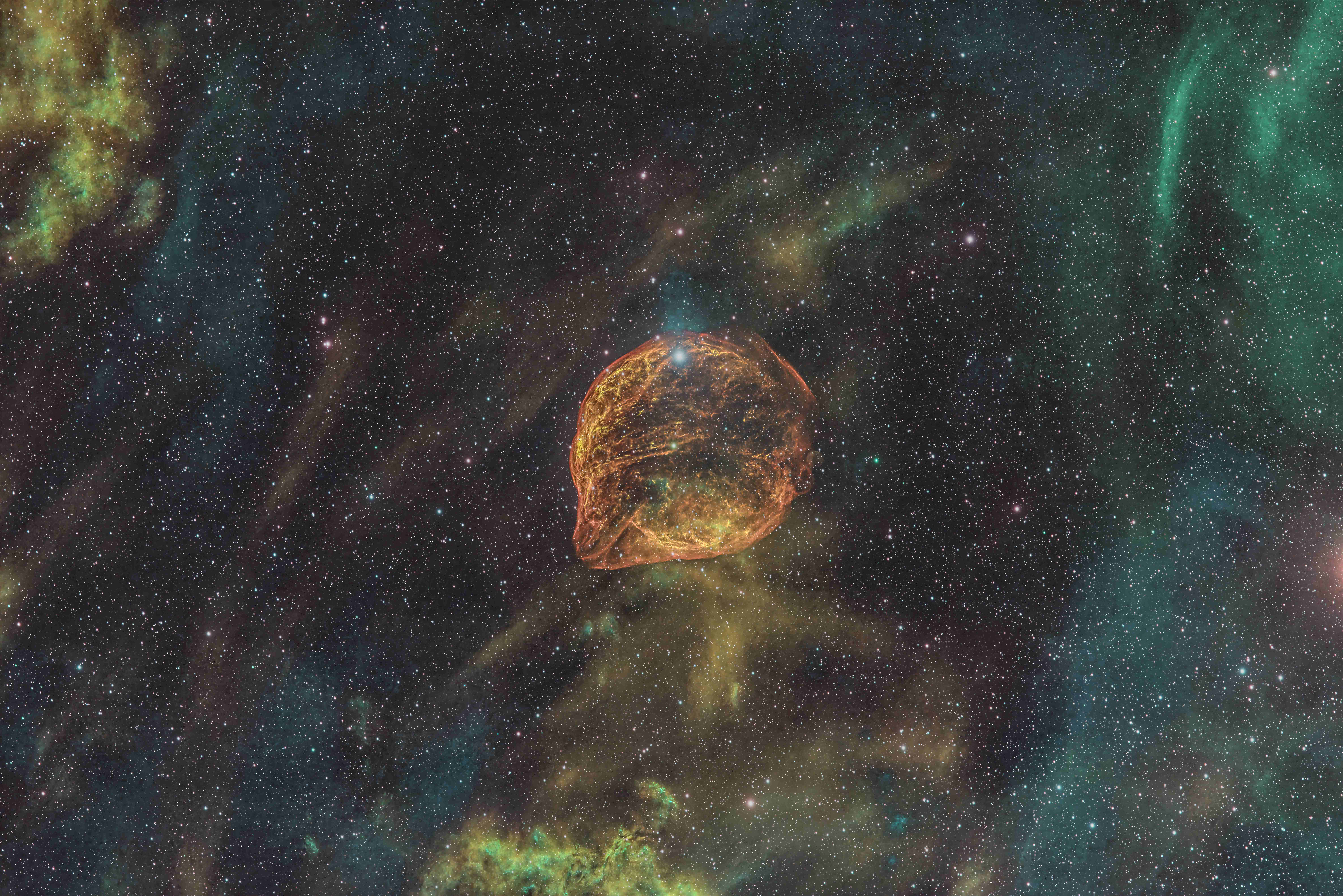
Sh2-308 - The Dolphin Head Nebula Not far from Sirius, the Dog Star, in the constellation Canis Major, lies the Dolphin Head Nebula. It is located in a Ha region. The nebula began its life about 70,000 years ago as the star in the center blew off its outer layers as it began its pre-supernova phase of life, and is made up of mostly Hydrogen and Oxygen gasses. It sits about 4530 light-years away and 60 light-years wide. The center star (EZ Canis Majoris) is a Wolf-Reyet star which means that it is extremely hot an luminous. It is pushing the expanding gasses outward at roughly 3.8 million mph. Image processed by Ron Yelton, original data from Telescope Live |
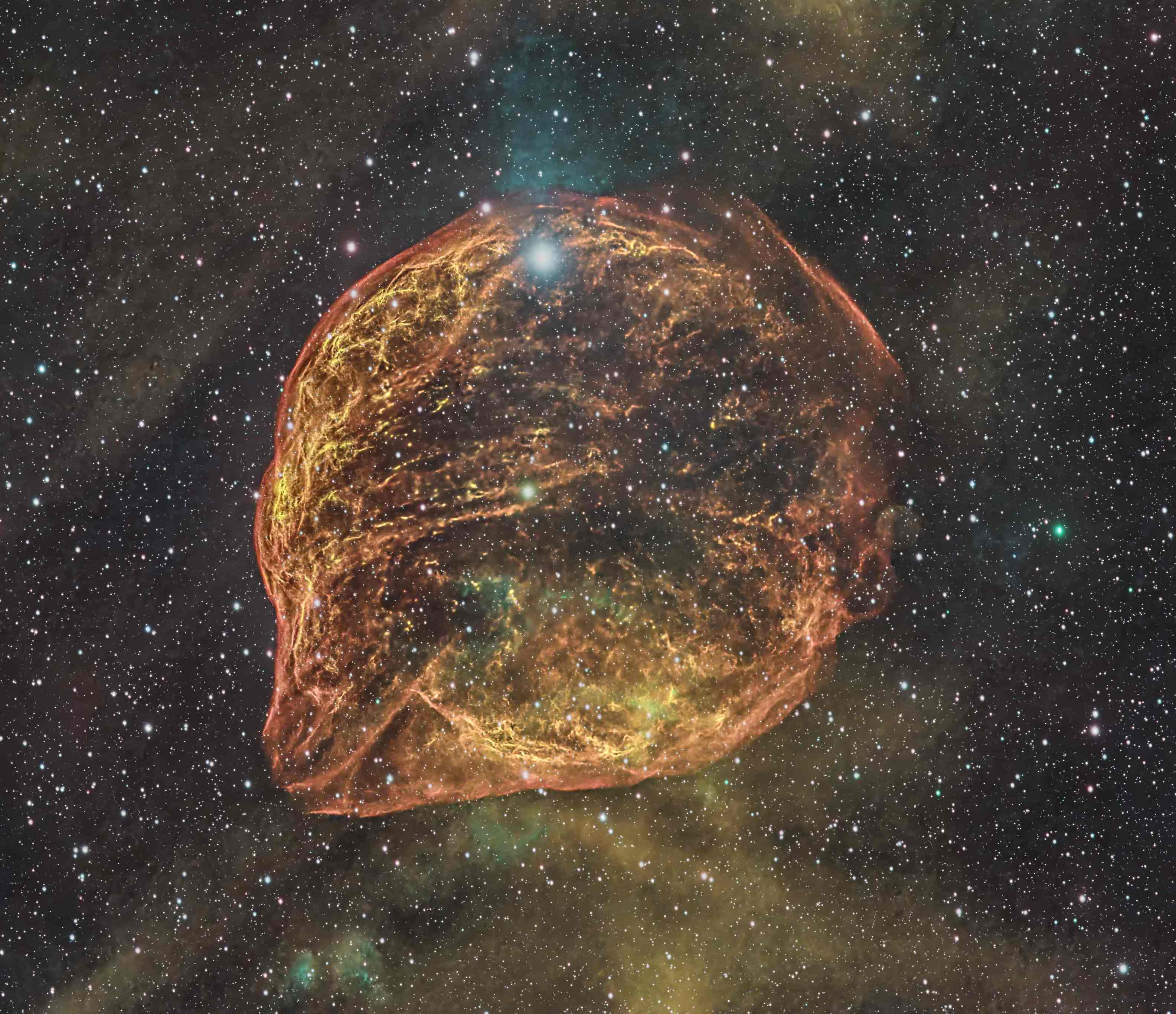
Sh2-308 - The Dolphin Head Nebula This is simply a much zoomed-in view of the Dolphin Head Nebula to the left. Image processed by Ron Yelton, original data from Telescope Live |
|
Location: El
Sauce Observatory, Chile
Date: January 2025 Mount: 10 Micron GM1000HPs Telescope: Nikon 200 F/2 (CHI-5) Camera: FLI ML16200 Exposure: 55 x 5 min for LRGB. Total: 4 hrs 35 min |
Location: Heaven's
Mirror Observatory, Australia
Date: December 2023 Mount: Paramount MX+ Telescope: FSQ-106ED (AUS-2) Camera: QHY600m @ -25c Exposure: 173 x 5 min each for H00 Total:14h hrs 20 min |
Location: Heaven's
Mirror Observatory, Australia
Date: December 2023 Mount: Paramount MX+ Telescope: FSQ-106ED (AUS-2) Camera: QHY600m @ -25c Exposure: 173 x 5 min each for H00 Total:14h hrs 20 min |
 |
 |
 |
| IC 59 (Sh2-185) - The Ghost of
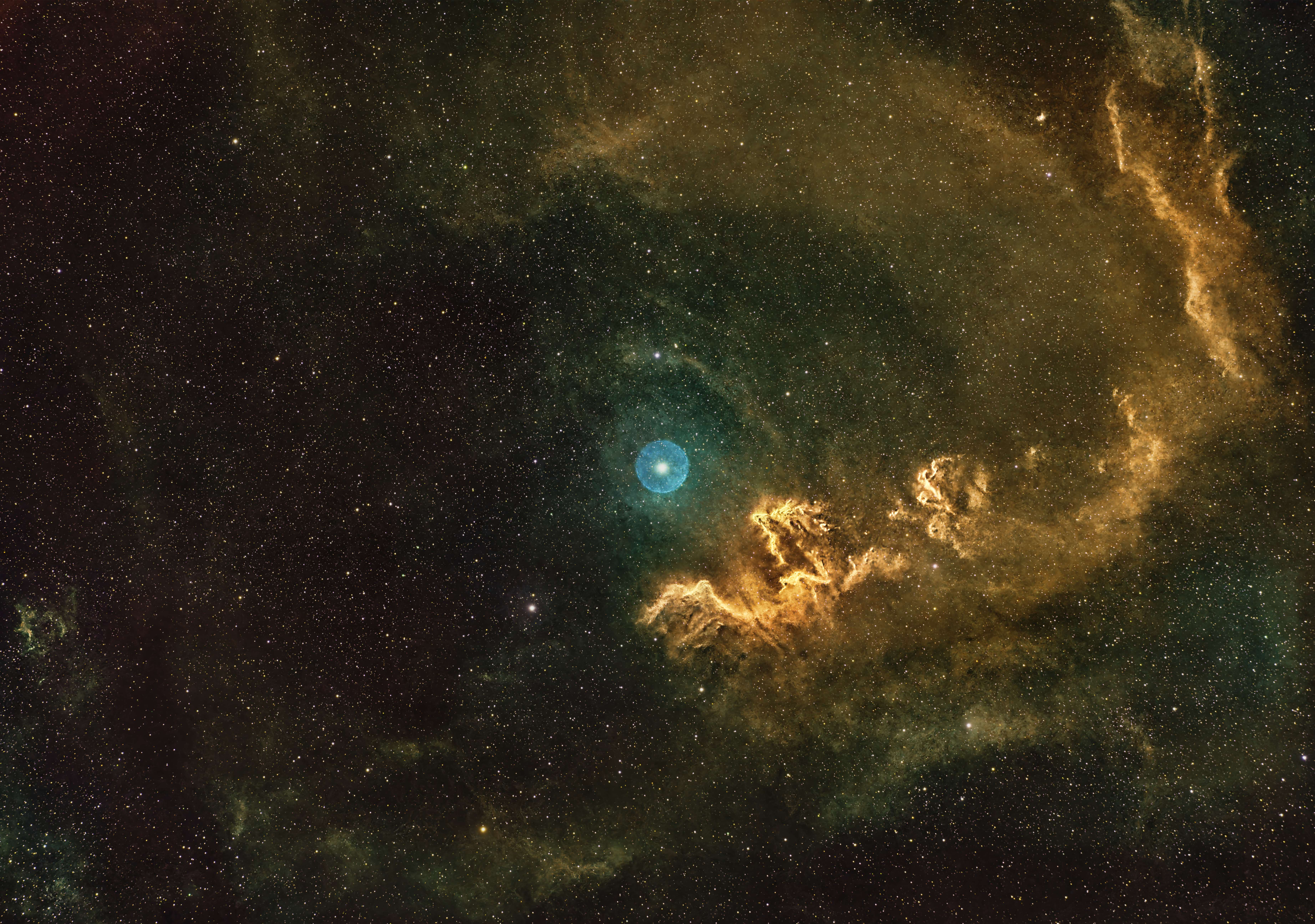
Cassiopeia IC 59 is both an emission and reflection nebula situated in the constellation of Cassiopeia. It sits around 600 light-years from Earth. When imaged with RGB filters, it usually appears blue in color. However, this image was shot with narrowband filters (SHO) which allows the processing to be done in just about any color. The central star (Gamma Cassiopeiae) appears to be a circular blue planetary nebula. This is just an artifact of the gaseous materials in the area. IC 63 is directly below the central star, while IC 59 is at its 4 o'clock position. Image processed by Ron Yelton, original data from Telescope Live |
LDN 1251 - The Rotten Fish Nebula This dark nebula is a molecular cloud and sits about 1000 light-years away from Earth in the constellation Cepheus. LDN stands for Lynd's Dark Nebula. Even though we can't see all of the star forming activity with visual telescopes, with radio and infrared we can peer into the interior to see that there are a considerable amount of new and forming stars there. The far right side of the nebula appears to have a bow shock wave, leading astronomers to believe that the entire nebula is moving through space at about mach 2. Image processed by Ron Yelton, original data from Telescope Live |
NGC 281 - The Pac Man Nebula Way out in the Perseus arm of the Milky Way is the constellation Cassiopeia. That's where this bright emission nebula resides. It sits about 9500 light-years away and has a diameter of about 96 light-years. Image processed by Ron Yelton, original data from Telescope Live |
|
Location: IC Astronomy Observatory, Spain
Date: February 2025 Mount: Paramount MX+ Telescope: Takahashi FSQ-106ED (SPA-1) Camera: QHY600m CMOS @ -25c Exposure: 27 x 5 min SHO Total: 2 hrs 15 min |
Location: Italy
Date: July 2025 Mount: Unknown Telescope: ASA N10 250 FL 900mm F/3.6 (T-23) Camera: Player One Mono 571 Exposure: 237 x 10 min each LRGB Total: 19hrs 35min |
Location: USA
Date: October - November 2017 Mount: Unknown Telescope: Planewave FL 2940mm f/6.8 Camera: FLI Proline PL16803 Exposure: 36 x 3 min each RGB Total: 1 hrs 15 min |
 |
 |
 |
| LDN 43 (Lynd's Dark Nebulae) - The
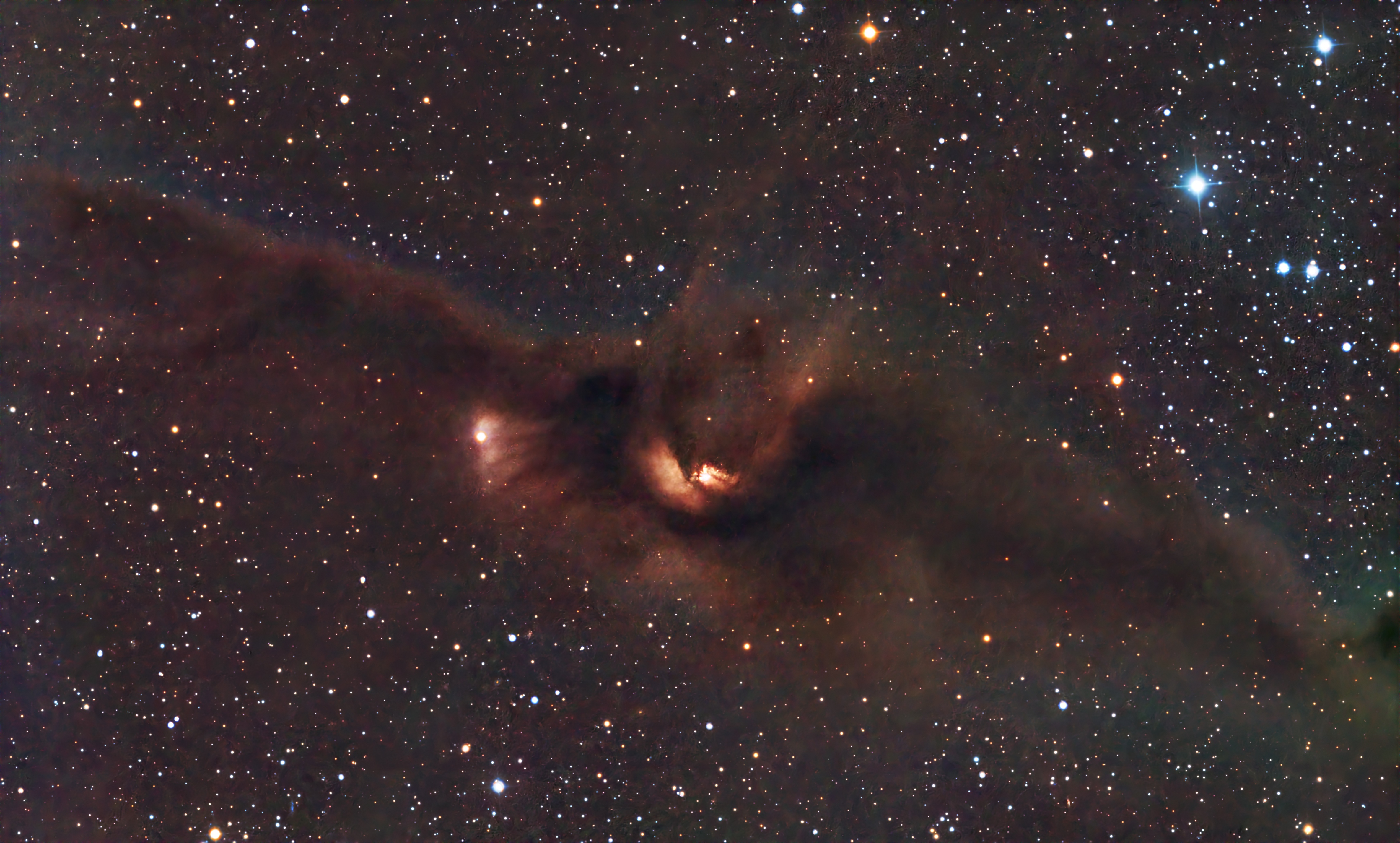
Cosmic Bat Nebula This dark nebula, in the constellation Ophiuchus, is a little deceptive in its appearance. The dark nebula that has the bat shape is actually in front of another, larger bright nebula behind it, which give it the look of a bat. The background nebula gives off enough light to contrast it against the background, but the bright areas inside the nebula are due to stellar nurseries where numerous new stars have, and are forming. It sits about 1400 light-years away and is about 9 light-years wide. Image processed by Ron Yelton, original data from Telescope Live |
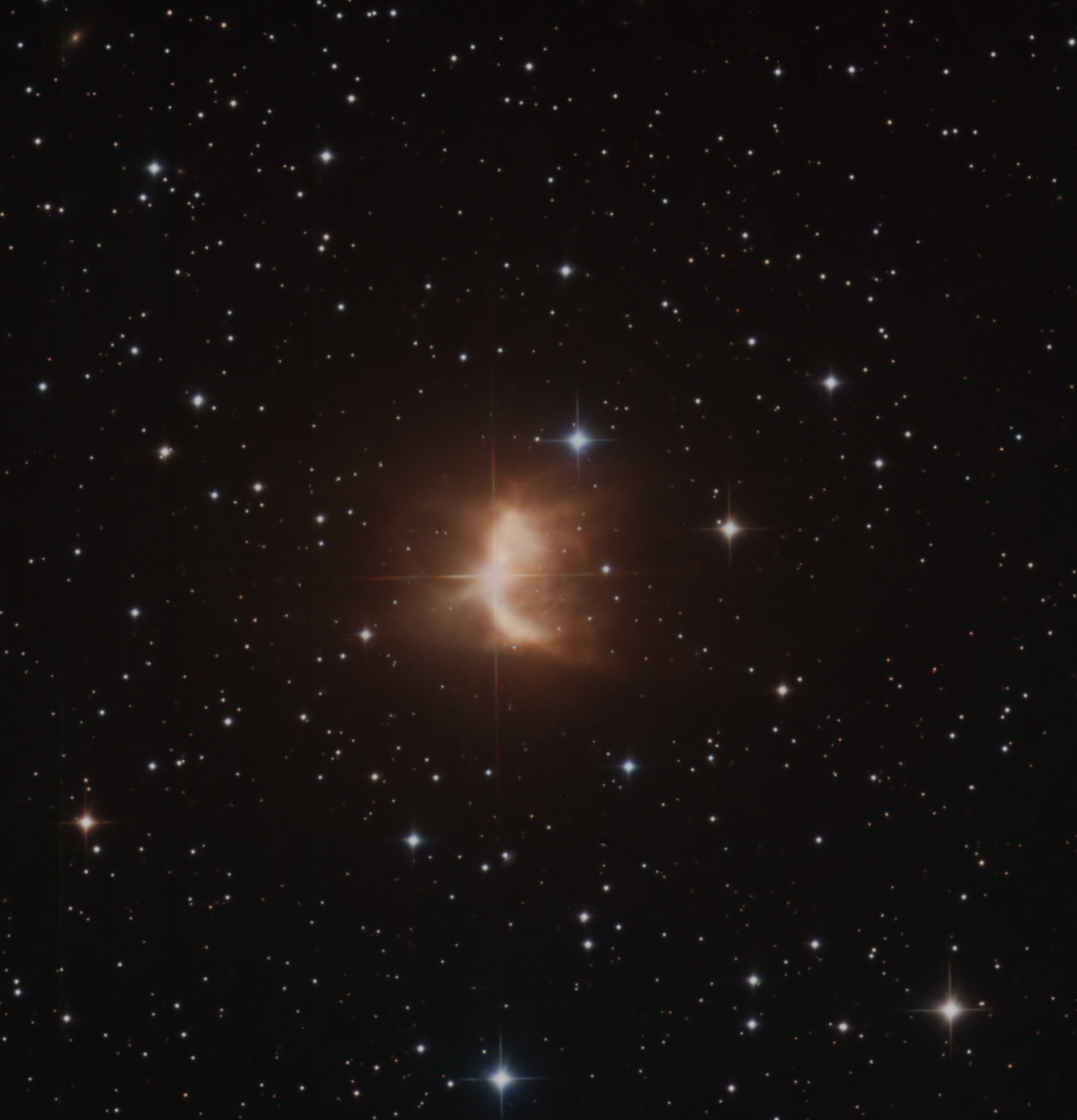
IC 2220 IC 2220 is also known as the Toby Jug Nebula. It sits in the constellation of Carina, about 1200 light-years away. It is also a reflection nebula. Image processed by Ron Yelton, original data from Telescope Live |
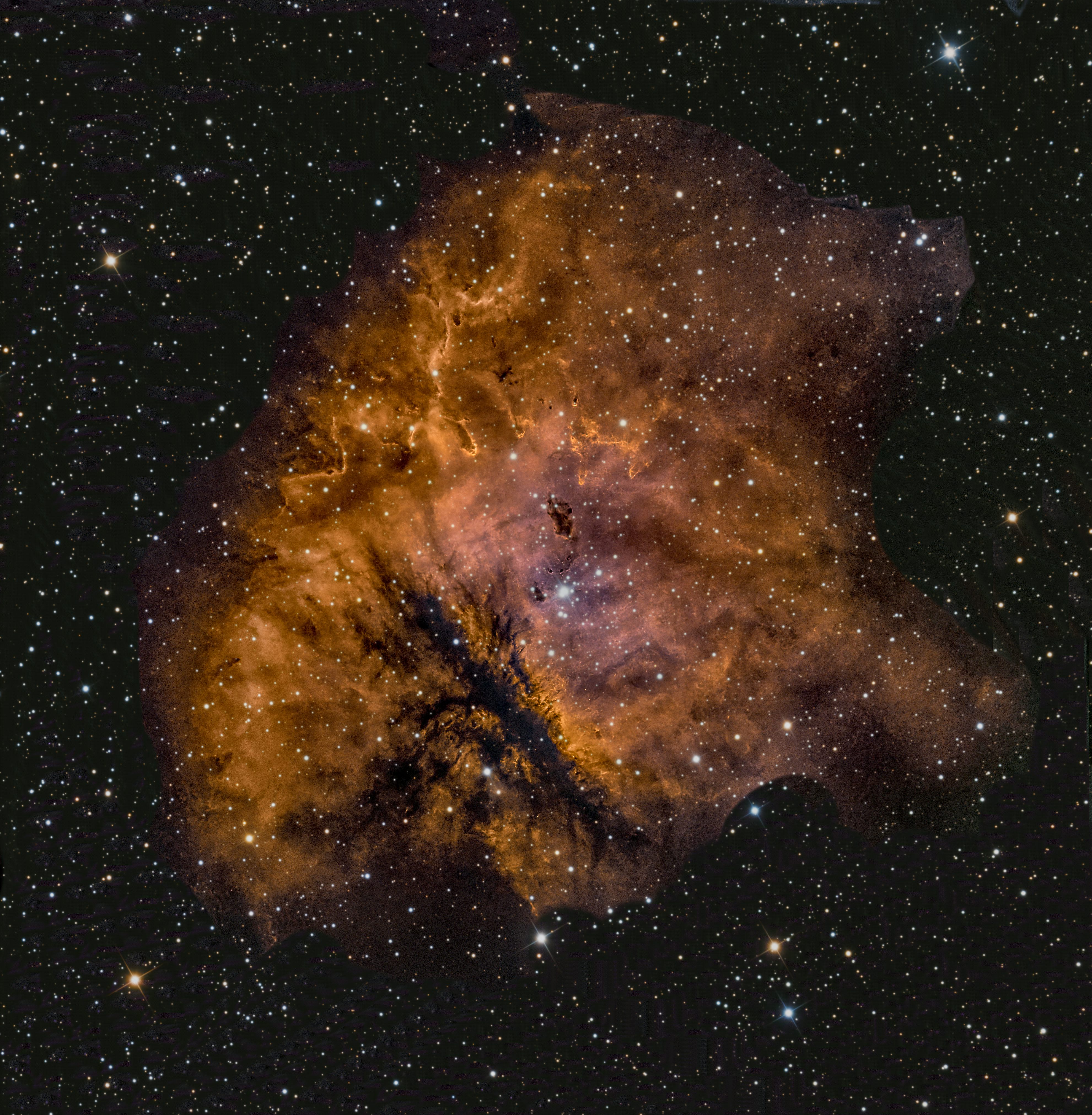
RCW 27 RCW 27 is an emission nebula in the constellation Vela and is part of the larger GUM Nebula. It is composed of mostly ionized hydrogen. Image processed by Ron Yelton, original data from Telescope Live |
|
Location: El
Sauce Observatory, Chile
Date: March 2025 Mount: Mathis MI-1000/1250 Telescope: Planewave CDK24 (CHI-1) Camera: QHY600m @-25c Exposure: 54 x 5 min for LRGB. Total: 4 hrs 30 min |
Location: El Sauce Observatory, Chile Date: March 22, 2020 Mount: Mathis MI-1000 Telescope: Planewave CDK24 f/6.6 (CHI-1) Camera: FLI PL9000 @ -25c Exposure: 9 x 10 min LRGB. Total 90 min. |
Location: Heaven's
Mirror Observatory, Australia
Date: February 2025 Mount: Paramount MX+ Telescope: FSQ-106ED (AUS-2) CCD Camera: QHY600m @ -25c Exposure: 81 x 5 min each for 0HS Total:6 hrs 45 min |
 |
 |
 |
|
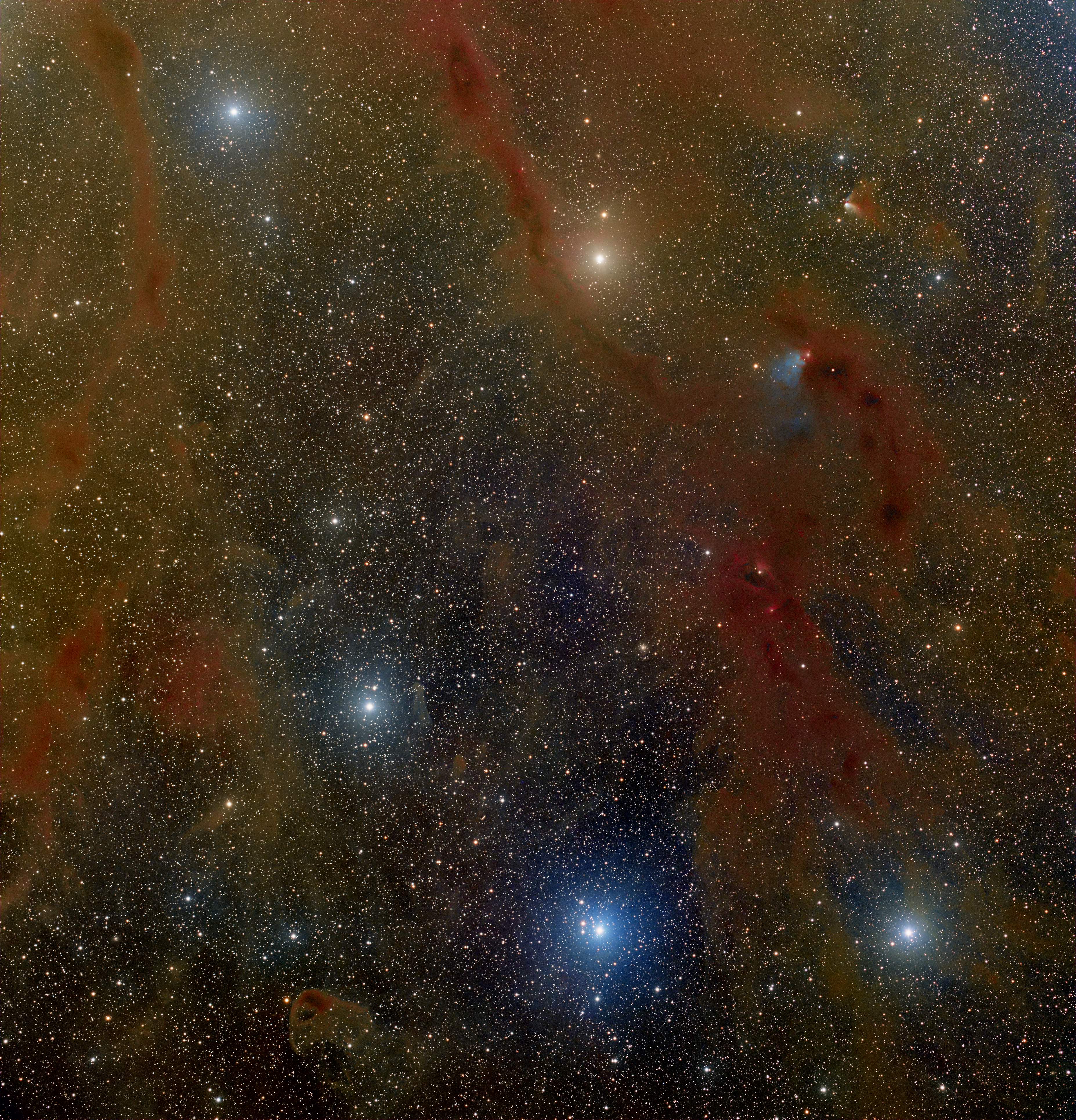
Barnard 7 Barnard 7 is a dark nebula in the constellation Taurus, and is part of the larger Taurus Molecular cloud Group. Image processed by Ron Yelton, original data from Telescope Live |
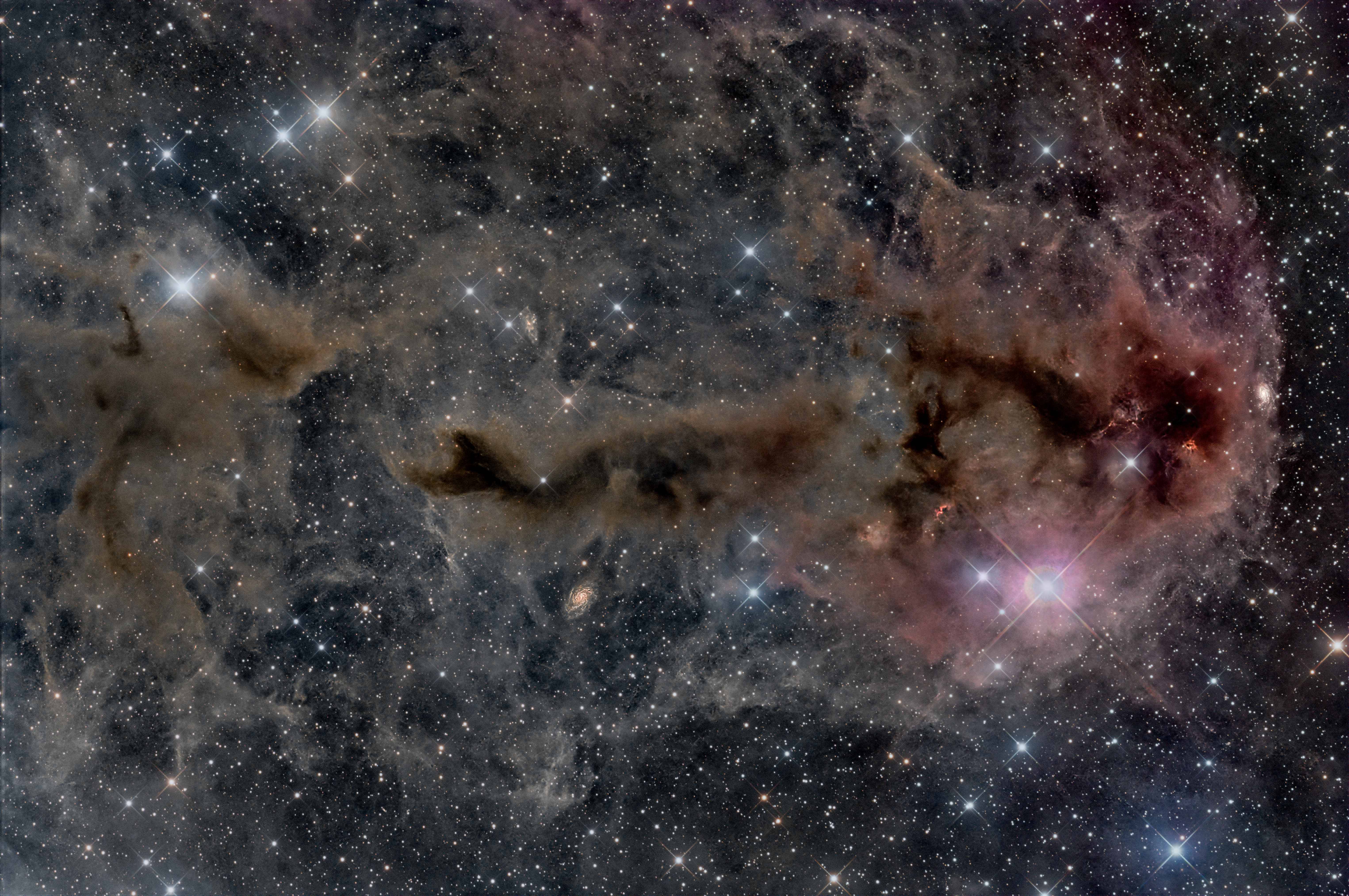
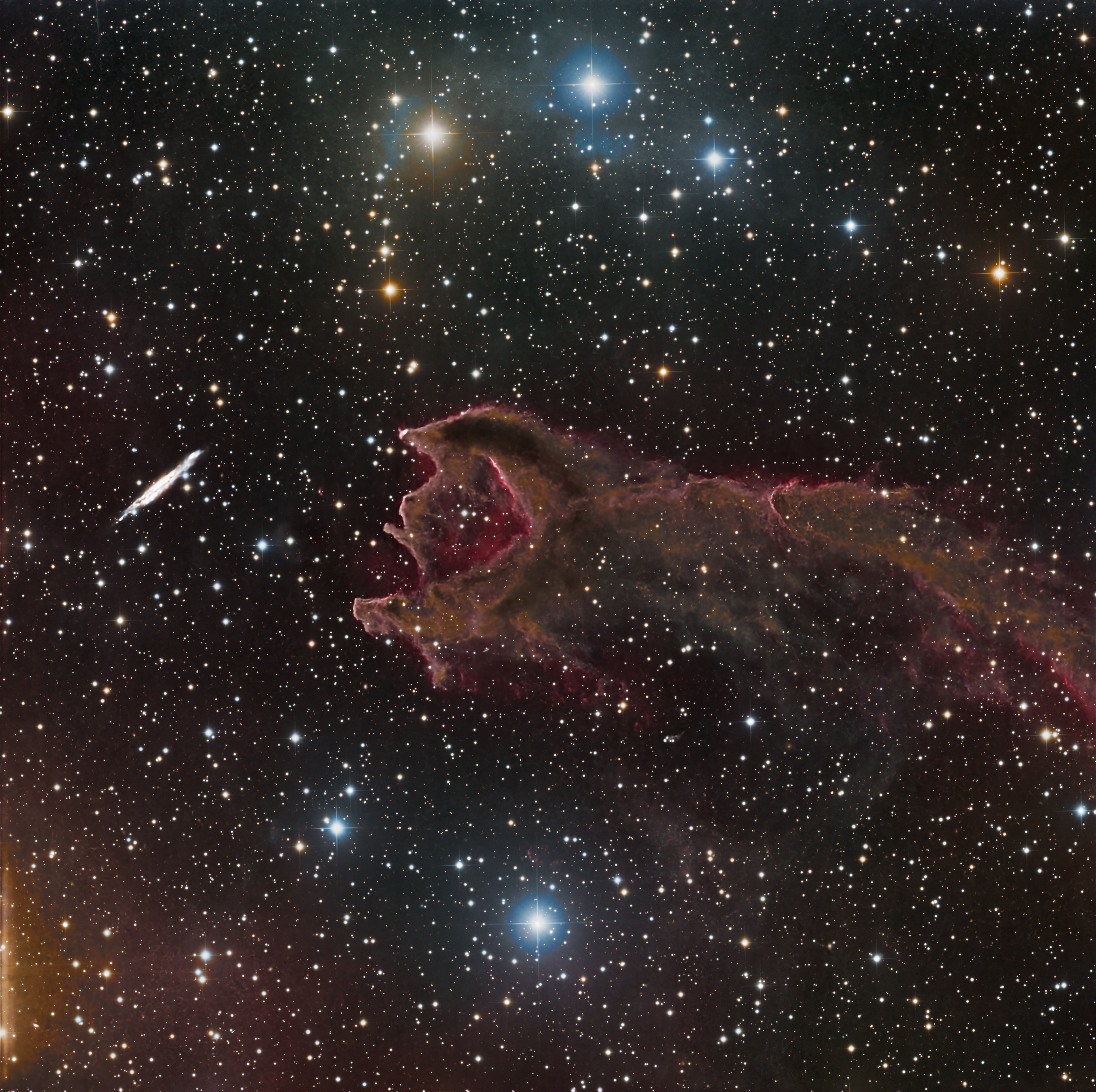
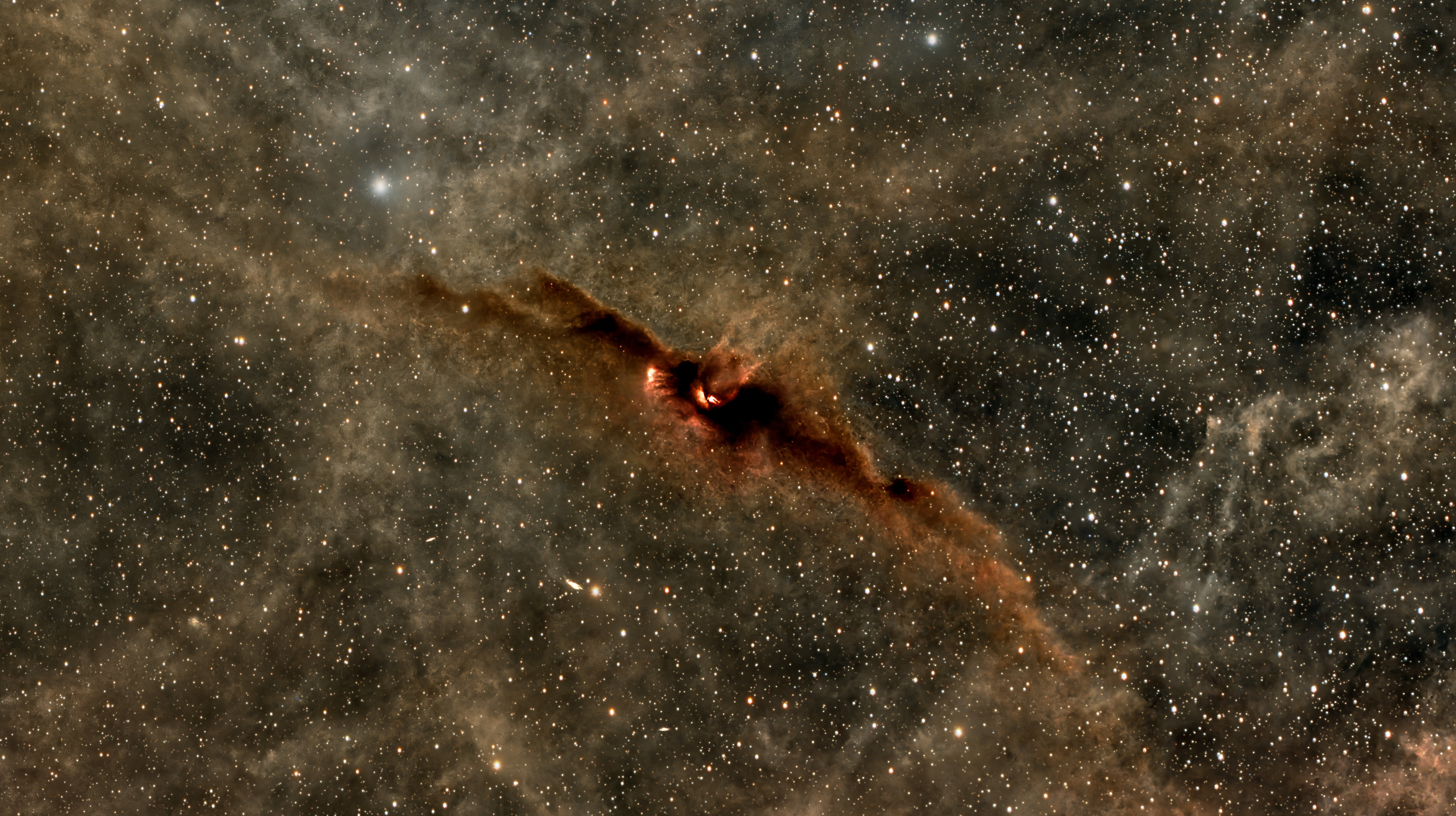
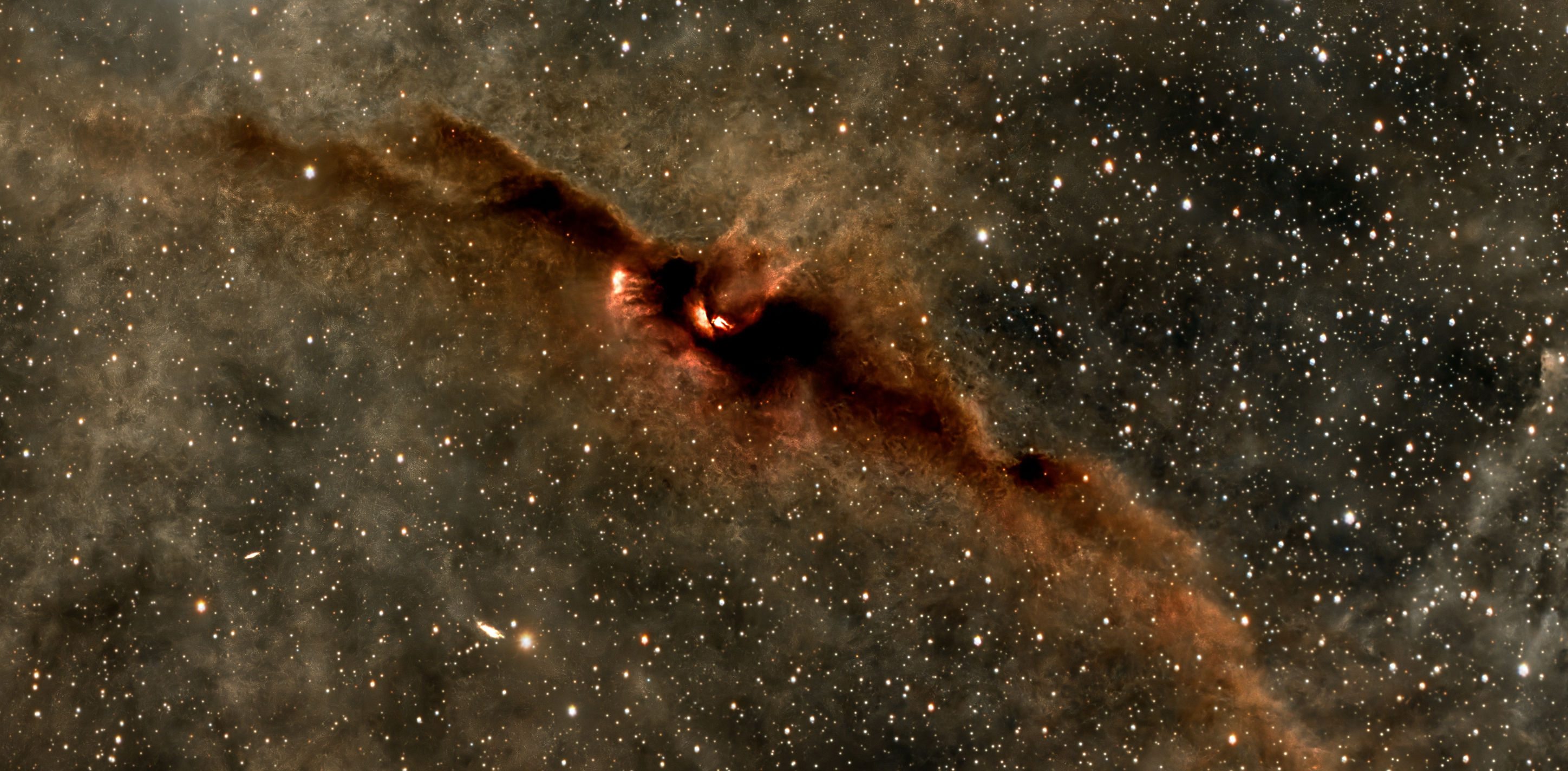
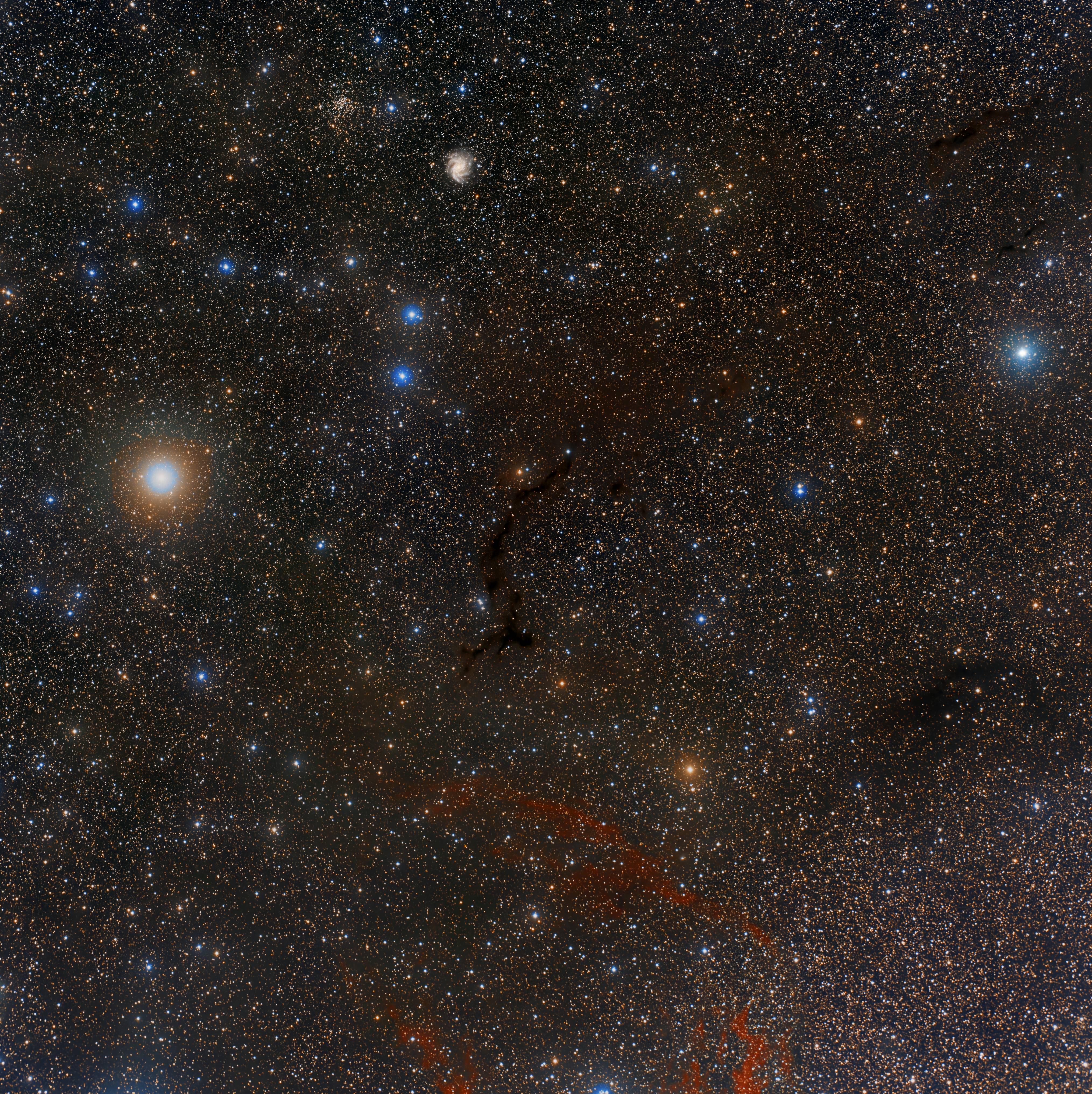
CG 4 - God's Hand This star forming region is located in the constellation Puppis. It sits about 1300 light-years away. The head area is about 1.5 light-years across and the tail section stretches about 8 light-years long. Although it appears to be a dark nebula, it is officially classified as a Cometary Globule, due to its comet-like shape. To me it looks more like one of the worms from the movie Dune as it reaches out to grab that nearby galaxy. Image processed by Ron Yelton, original data from Telescope Live |
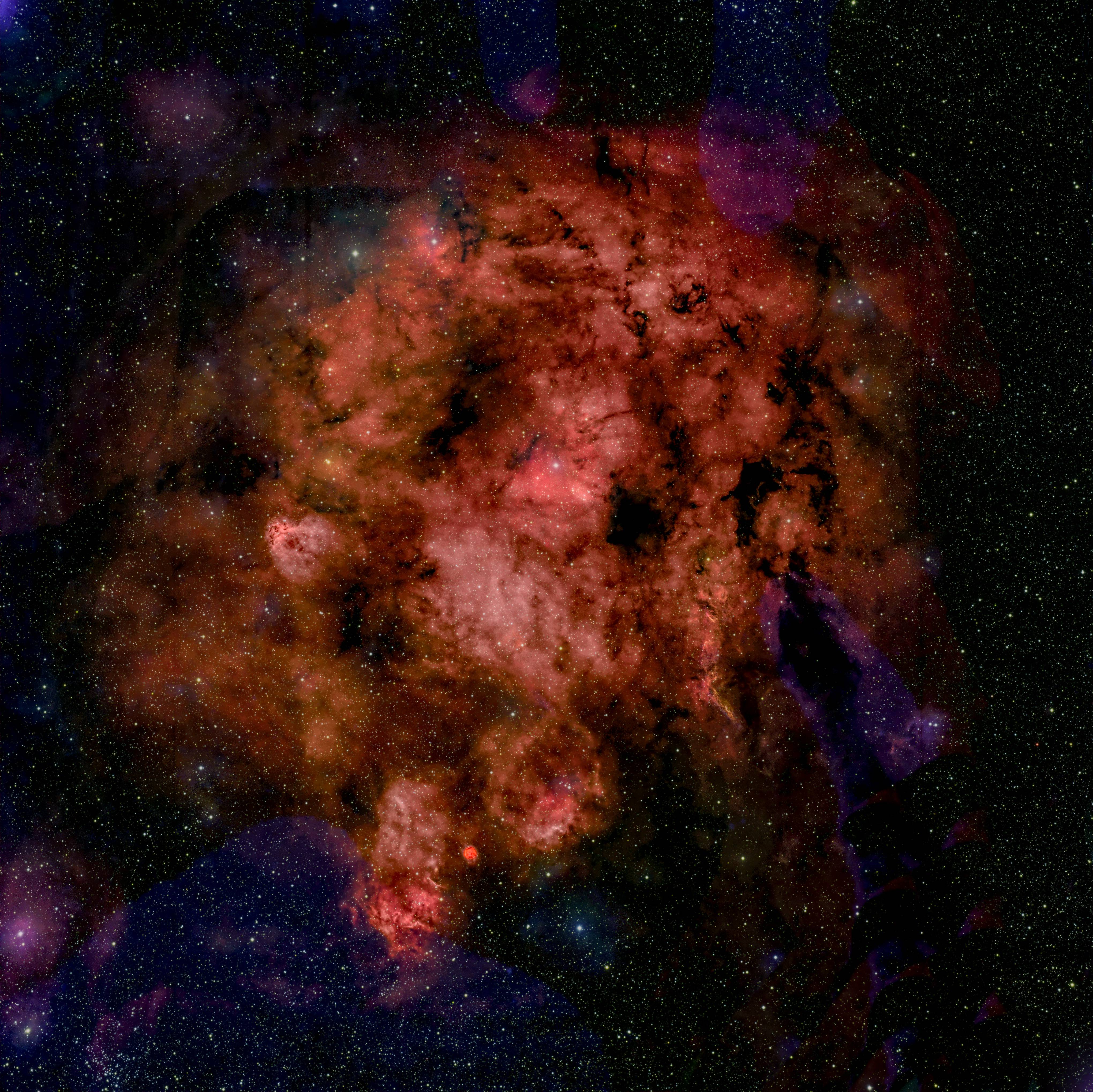
LBN 696 LBN stands for Lynd's Bright Nebulae This is a bright nebula made up of mostly ionized hydrogen (HII). The reddish areas are hydrogen and the pinkiish/purple areas are oxygen gasses.I mage processed by Ron Yelton, original data from Telescope Live |
|
Location: IC Astronomy Observatory, Spain
Date: December 2021 Mount: Paramount MX+ Telescope: Takahashi FSQ-106ED (SPA-1) Camera: FLI PL16083 CCD @ -25c Exposure: 44 x 10min LRGB Total: 7 hrs 20min: |
Location: El Sauce Observatory,
Chile Date: December 2022 Mount: Mathis MI-1000 Telescope: Planewave CDK24 f/6.6 (CHI-1) Camera: FLI PL9000 @ -25c Exposure: 80 x 10 min LRGB. Total 13 hrs 20 min. |
Location:
IC Astronomy Observatory, Spain Date: August 2022- September 2023 Mount: Paramount MX+ Telescope: FSQ-106EDX4 (SPA-3) Camera: FLI PL16083 Exposure: 80 x 10 min for HSO. Total: 13 hr 20 min |
 |
 |
 |
| LDN 43 - The Cosmic Bat Nebula What a cool bat! This one is a dark nebula that is lit up from the inside by hot, young stars. The exterior is lit by nearby LDN 7, another stellar nursery. From wingtip to wingtip it is about 12 light-years across. It sits about 1400 light-years away in the constellation Ophiuchus. This one and the next two were taken with a wide-field camera (382mm), I zoomed in a couple of times. The Cosmic Bat a couple of rows above was taken with the 24" PLanewave. Image processed by Ron Yelton, original data from Telescope Live |
LDN 43 - The Cosmic Bat Nebula A Little closer, now. Image processed by Ron Yelton, original data from Telescope Live |
LDN 43 - The Cosmic Bat Nebula Up close and personal. Image processed by Ron Yelton, original data from Telescope Live |
|
Location: Heaven's
Mirror Observatory, Australia
Date: February - July 2025 Mount: Paramount MX+ Telescope: FSQ-106ED (AUS-2) Camera: QHY600m @ -25c Exposure: 120 x 5 min each for H00 Total:10 hrs |
Location: Heaven's
Mirror Observatory, Australia
Date: February - July 2025 Mount: Paramount MX+ Telescope: FSQ-106ED (AUS-2) Camera: QHY600m @ -25c Exposure: 120 x 5 min each for H00 Total:10 hrs |
Location: Heaven's
Mirror Observatory, Australia
Date: February - July 2025 Mount: Paramount MX+ Telescope: FSQ-106ED (AUS-2) Camera: QHY600m @ -25c Exposure: 120 x 5 min each for H00 Total:10 hrs |
|
 |
 |

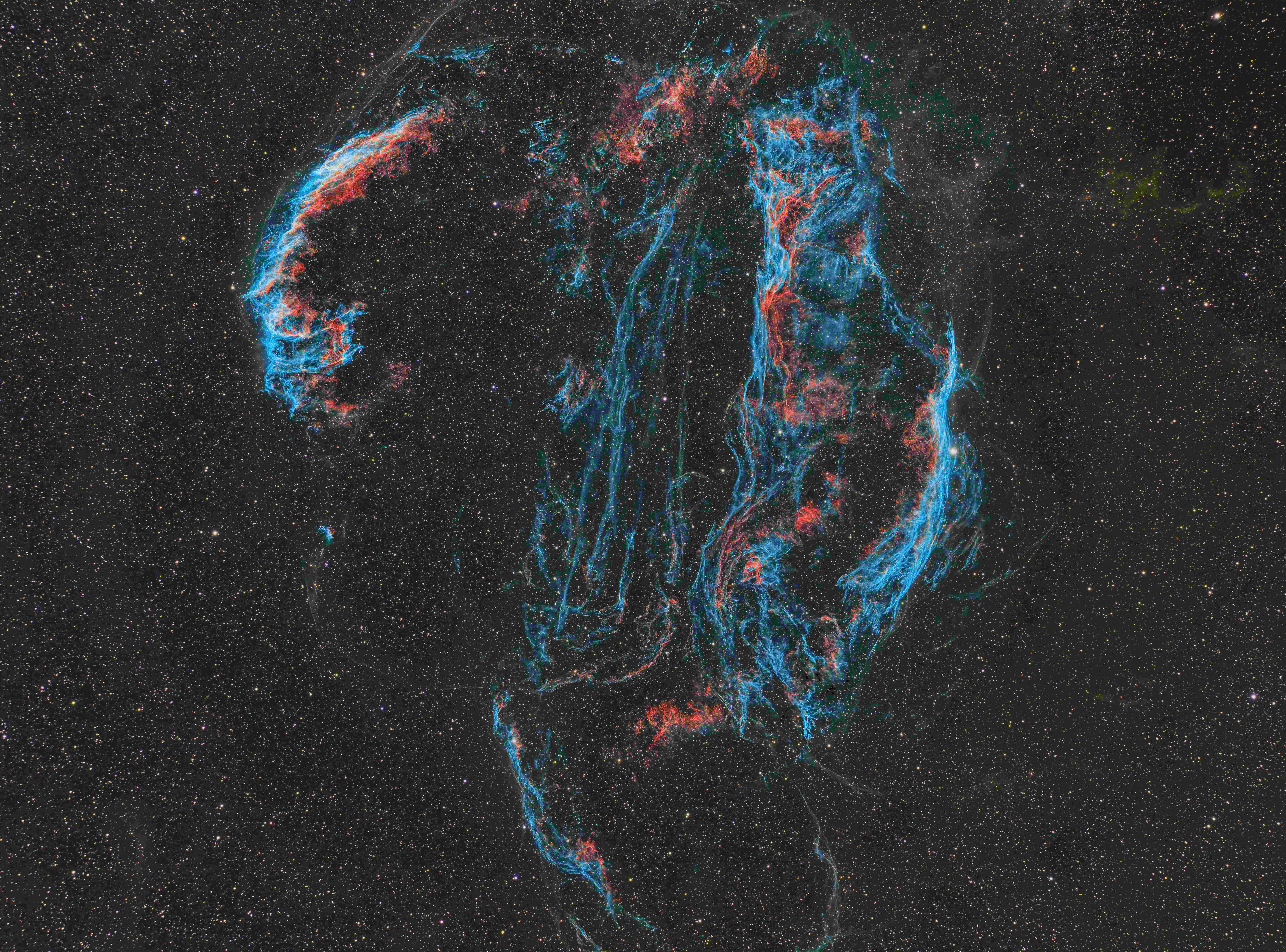
| Sh2-103 - The veil Nebula The Veil Nebula is just a small part of the much large Cynus Loop. It consists of may sub-objects with their own names and designation numbers. It was formed when a star about 100 times the size of Earth went supernova between 10,000 and 20,000 years ago. This version was post-processed in the HOS palette. Image processed by Ron Yelton, original data from Telescope Live |
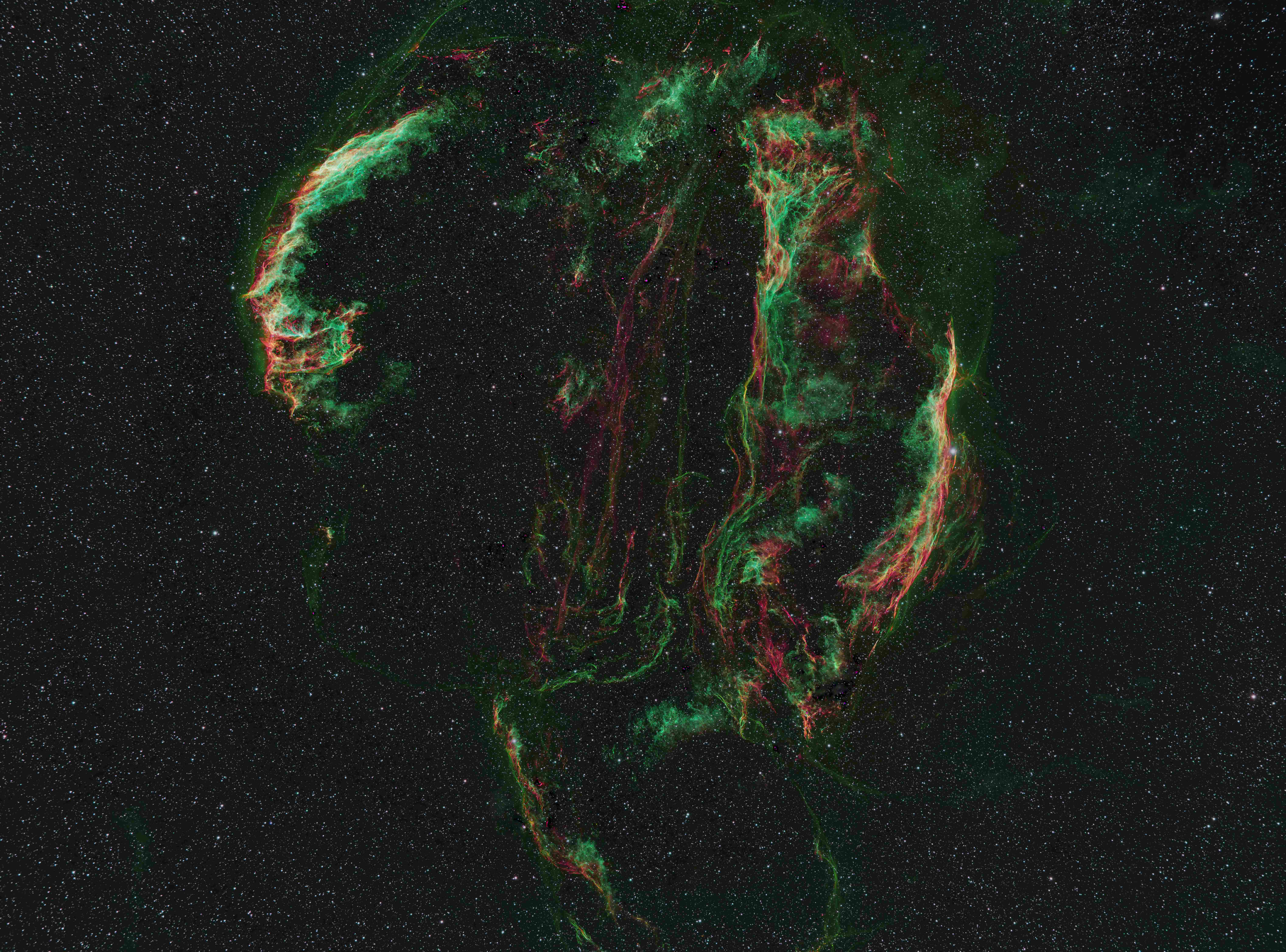
Sh2-103 - The veil Nebula This is the same image as the one to the left - except that it was post=processed in the OHS palette. Image processed by Ron Yelton, original data from Telescope Live |
Sh2-103 - The veil Nebula Again, the same image as the ones to the left. This one post-processed in the SHO palette. These three examples show how different an image can turn out just by assigning the narrow band color channels in a creative way. Image processed by Ron Yelton, original data from Telescope Live |
|
Location: IC Astronomy Observatory, Spain
Date: June - July 2023 Mount: Paramount MX+ Telescope: Takahashi FSQ-106ED (SPA-1) Camera: QHY600m CMOS @ -25c Exposure: 54 x 5 min HOS Total: 4 hrs 30 min |
Location: IC Astronomy Observatory, Spain
Date: June - July 2023 Mount: Paramount MX+ Telescope: Takahashi FSQ-106ED (SPA-1) Camera: QHY600m CMOS @ -25c Exposure: 54 x 5 min OHS Total: 4 hrs 30 min |
Location: IC Astronomy Observatory, Spain
Date: June - July 2023 Mount: Paramount MX+ Telescope: Takahashi FSQ-106ED (SPA-1) Camera: QHY600m CMOS @ -25c Exposure: 54 x 5 min SHO Total: 4 hrs 30 min |
 |
 |
 |
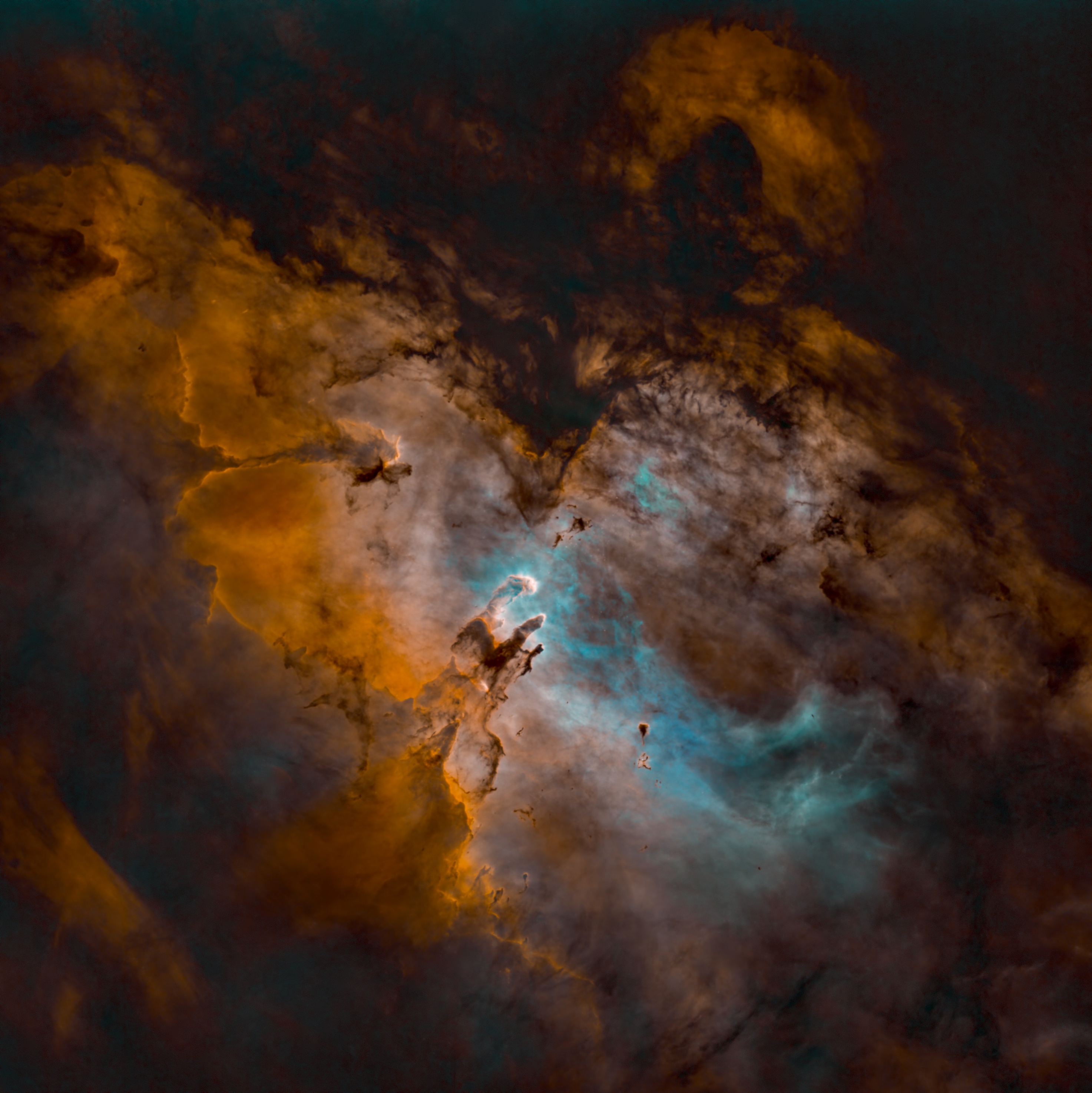
| Messier 16 - The Eagle Nebula or
The Pillars of Creation (HOS) Featured as one of the Hubble telescope's most iconic images, the Pillars of Creation are locates in the constellation Serpens, and lies about 5700 light-years away from us. The nebula itself is a diffuse emission nebula which is undergoing active star formation There is also an open cluster right in the center that consists of about 8100 stars. This image was processed in the HOS palette. The following images are processed with different combinations in order to show how different details show up using different filters. Image processed by Ron Yelton, original data from Telescope Live |
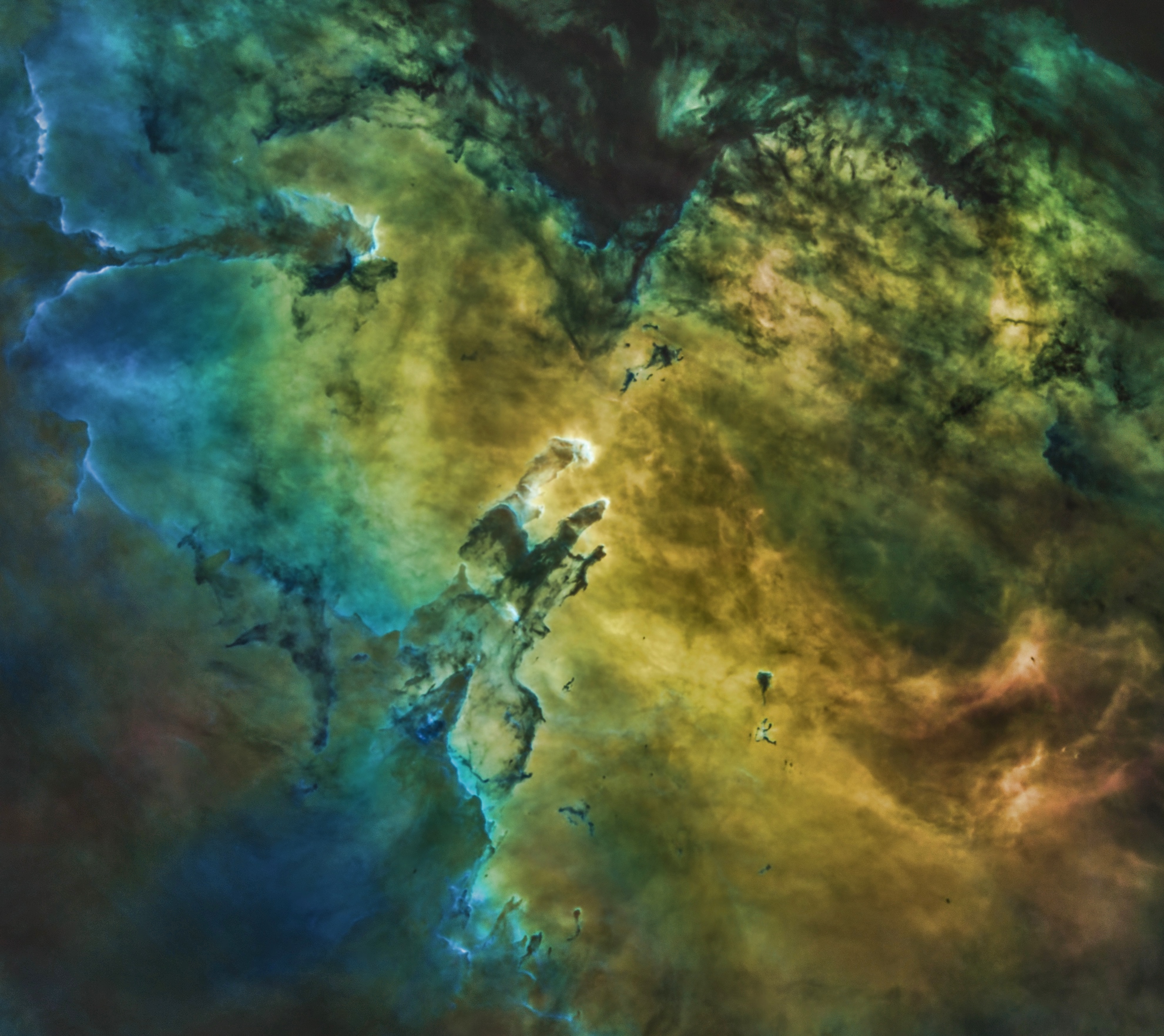
Messier 16 - The Eagle Nebula or
The Pillars of Creation (OHS) This image was processed in the OHS palette. Image processed by Ron Yelton, original data from Telescope Live |
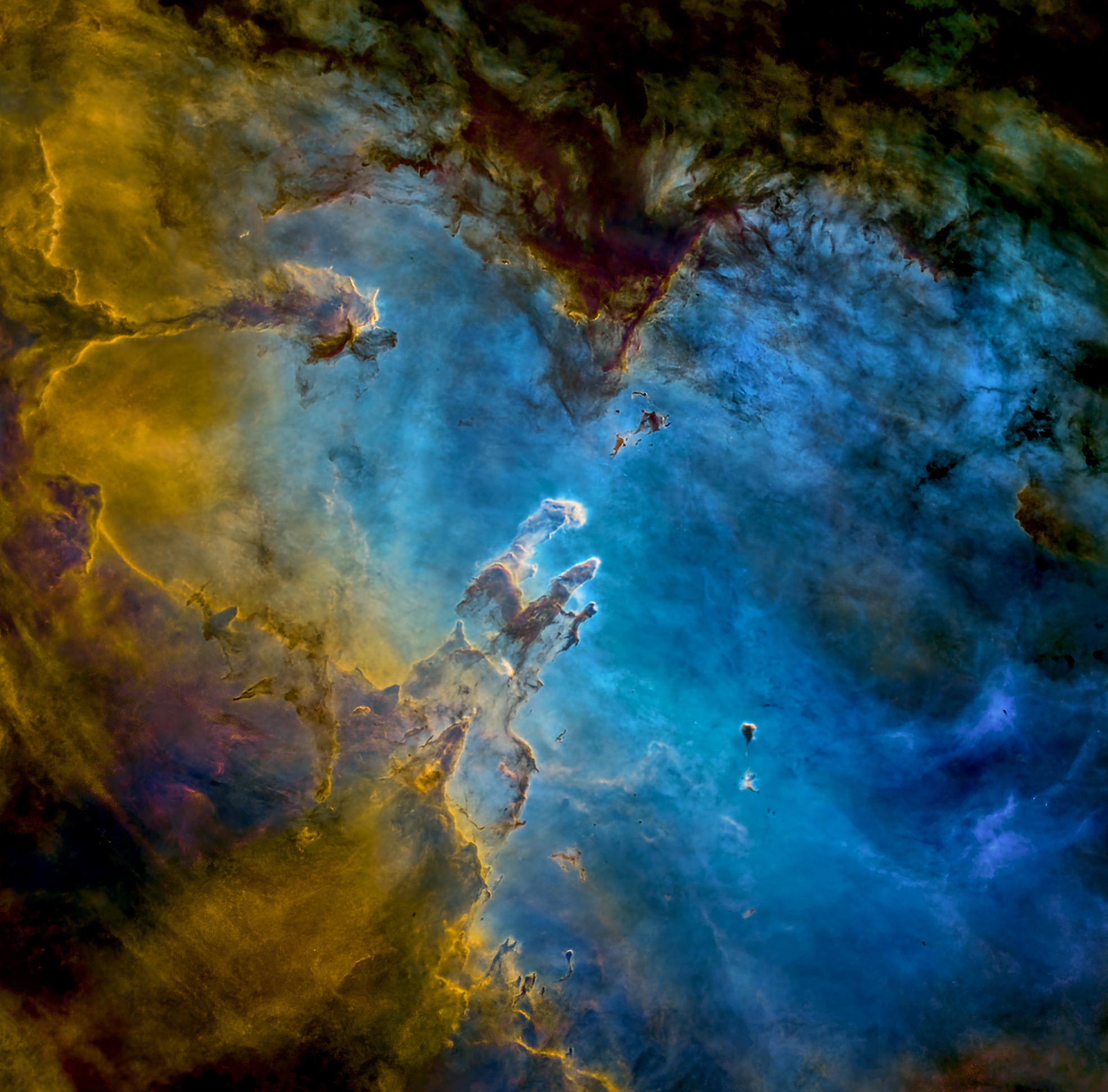
Messier 16 - The Eagle Nebula or
The Pillars of Creation (SHO) This image was processed in the SHO palette. Image processed by Ron Yelton, original data from Telescope Live |
|
Location:
El Sauce Observatory, Chile Date: December 2022 Mount: Mathis MI-1000 Telescope: Planewave CDK24 f/6.6 (CHI-1) Camera: FLI PL9000 @ -25c Exposure: 265 x 10 min HOS Total 40 hrs 10 min. |
Location: El Sauce Observatory,
Chile Date: December 2022 Mount: Mathis MI-1000 Telescope: Planewave CDK24 f/6.6 (CHI-1) Camera: FLI PL9000 @ -25c Exposure: 265 x 10 min OHS Total 40 hrs 10 min. |
Location: El Sauce
Observatory, Chile Date: December 2022 Mount: Mathis MI-10 Telescope: Planewave CDK24 f/6.6 (CHI-1) Camera: FLI PL9000 @ -25c Exposure: 265 x 10 min SHO Total 40 hrs 10 min. |
 |
 |
 |
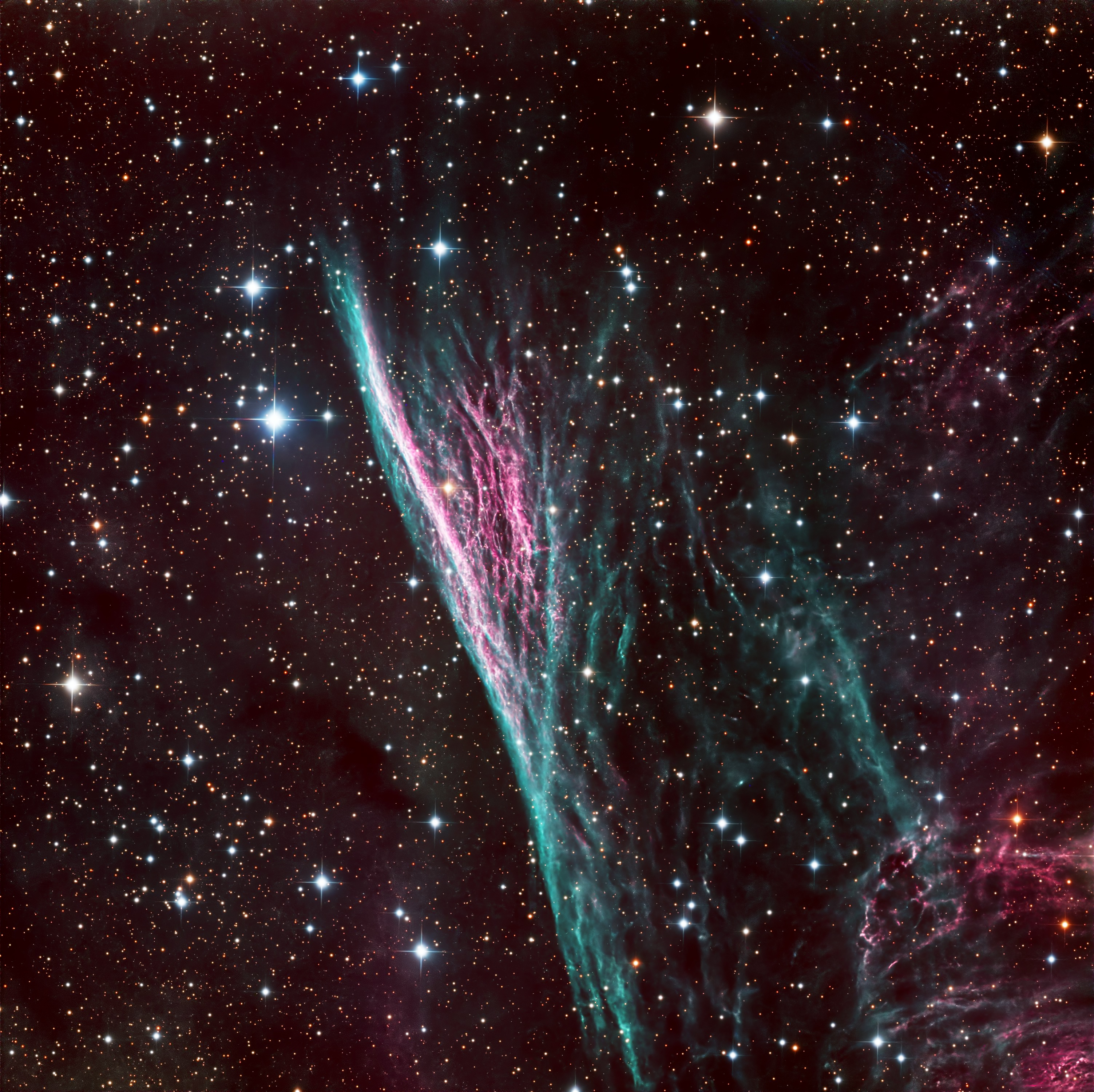
| NGC 2736 - The Pencil Nebula This nebula is just a very small part of the larger Vela Nebula, which is a Supernova Remnant. It is located in the constellation Vela. It sits about 815 light-years away from us and is thought o have been formed as a result of the leading shock-wave from the expanding supernova gas. It is moving along at a comfortable 400,000 mph. Image processed by Ron Yelton, original data from Telescope Live |
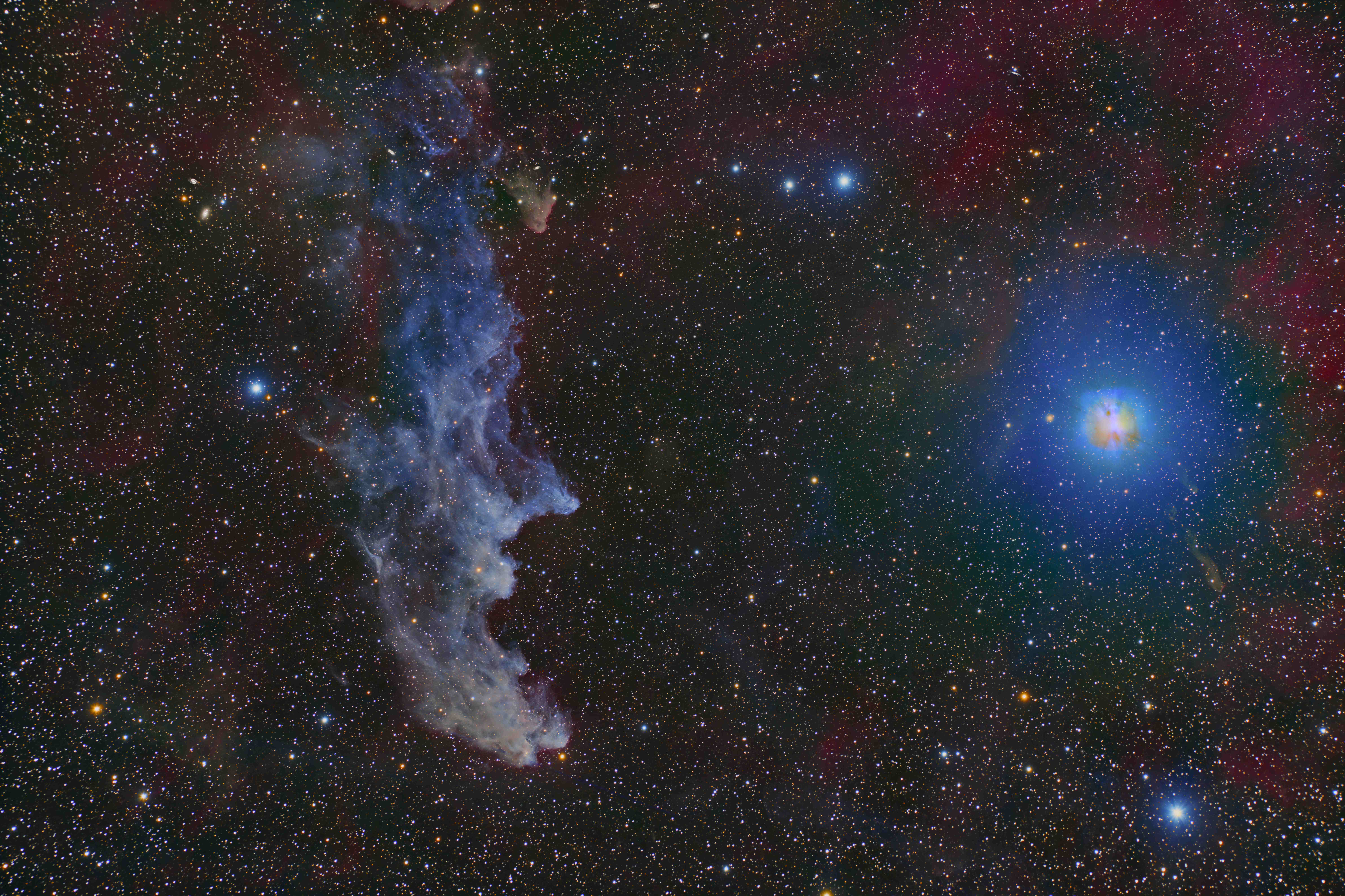
IC 2118 - The Witch Head Nebula This reflection nebula is very, very faint and is believed to be the leftovers of an ancient supernova remnant. It sits about 900 light-years away. Although the nebula itself is in the constellation Eridanus, it is illuminated by its neighboring star, Rigel, in the constellation Orion. Image processed by Ron Yelton, original data from Sacramento Valley Astronomical Society |
Cederblad 90 Also known as Sh2-297, this is an emission nebula at the tip of the Seagull Nebula in Canis Major. It has, deeply embedded, a very active star-making area, as well as numerous established variable stars. Image processed by Ron Yelton, original data from Telescope Live |
|
Location: El Sauce
Observatory, Chile Date: December 2022 Mount: Mathis MI-1000 Telescope: Planewave CDK24 f/6.6 (CHI-1) Camera: FLI PL9000 @ -25c Exposure: 75 x 5 min HRGB. Total 6 hrs 15 min. |
Location: Blue
Canyon Airport, Ca Date: December 2025 Mount: Unknown Telescope: Skywatcher FL = 385 Camera: QHY600m CMOS @ -25c Exposure: Unknown LRGB. Total ? hrs ? min. |
Location: El Sauce Observatory, Chile Date: January 2020 Mount: ASA Alt-Az Telescope: ASA RC-1000AZ (CHI-3) Camera: FLI PL16803 @ -25c Exposure: 10 x 3 min LRGB. Total 30 min. |
 |
 |
 |
|
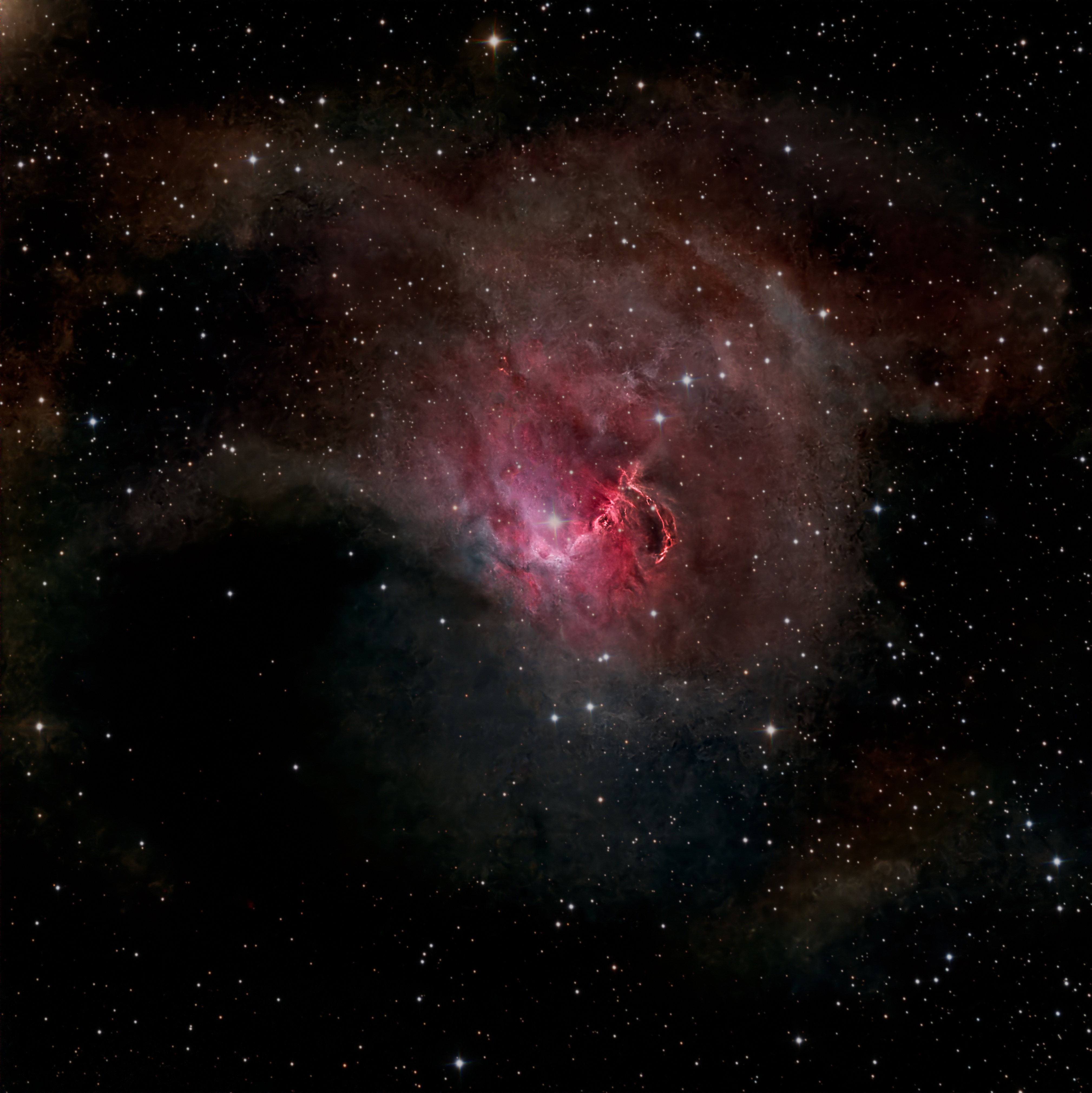
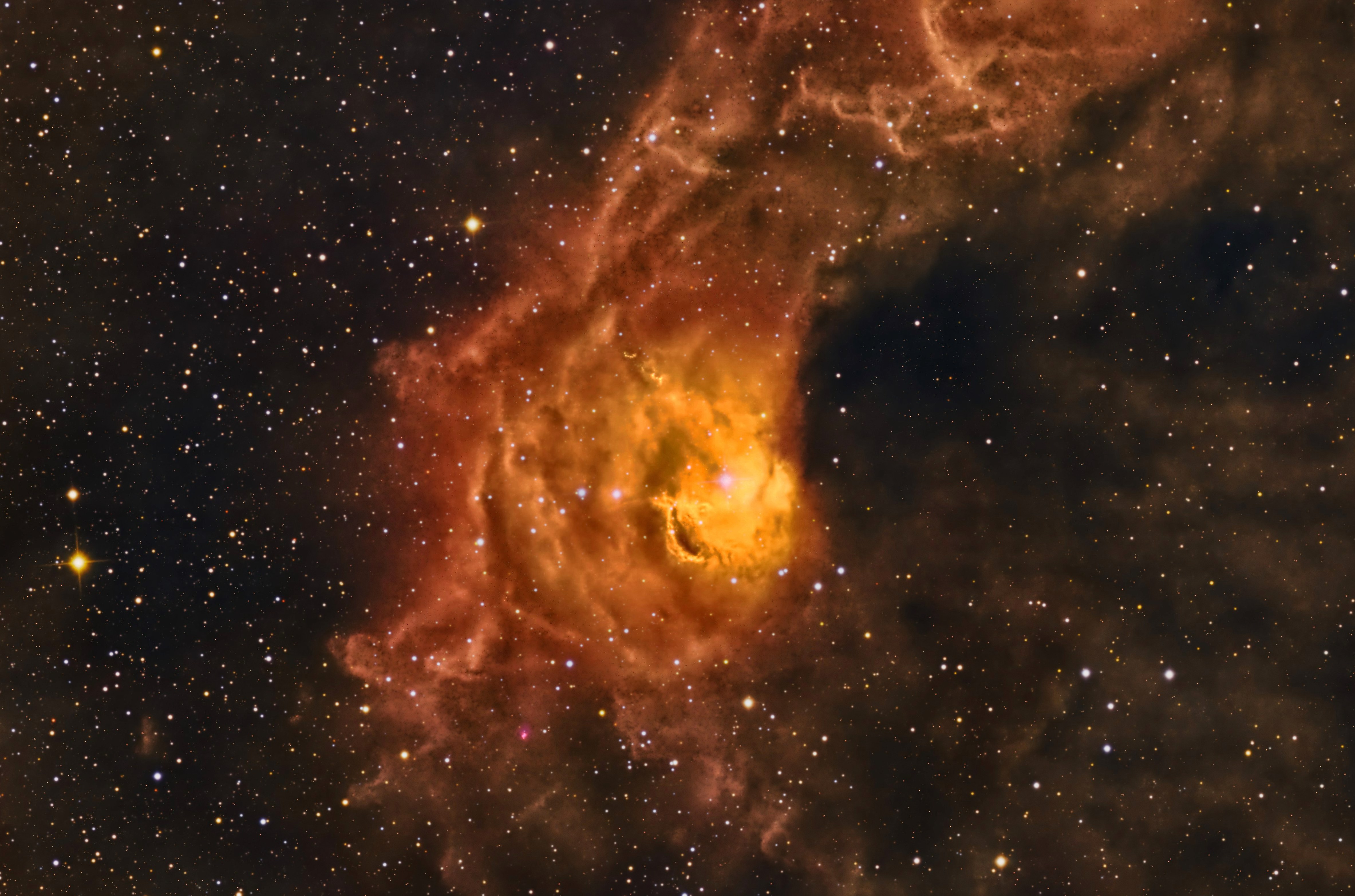
Sh2-297 This object is an emission nebula that sits in the constellation of Canis Major. It is actually the bright area in the center, and is part of the larger nebula Sh2-296 (The Seagull Nebula). it is about 4000 light-years away from us. Image processed by Ron Yelton. Original data from Telescope Live |
IC 2087 Sitting about 430 light-years away is IC 2087, a small reflection nebula. It is near the center of the extremely large Taurus Molecular Cloud Complex. Image processed by Ron Yelton. Original data from Telescope Live courtesy of Nic Szymanek |
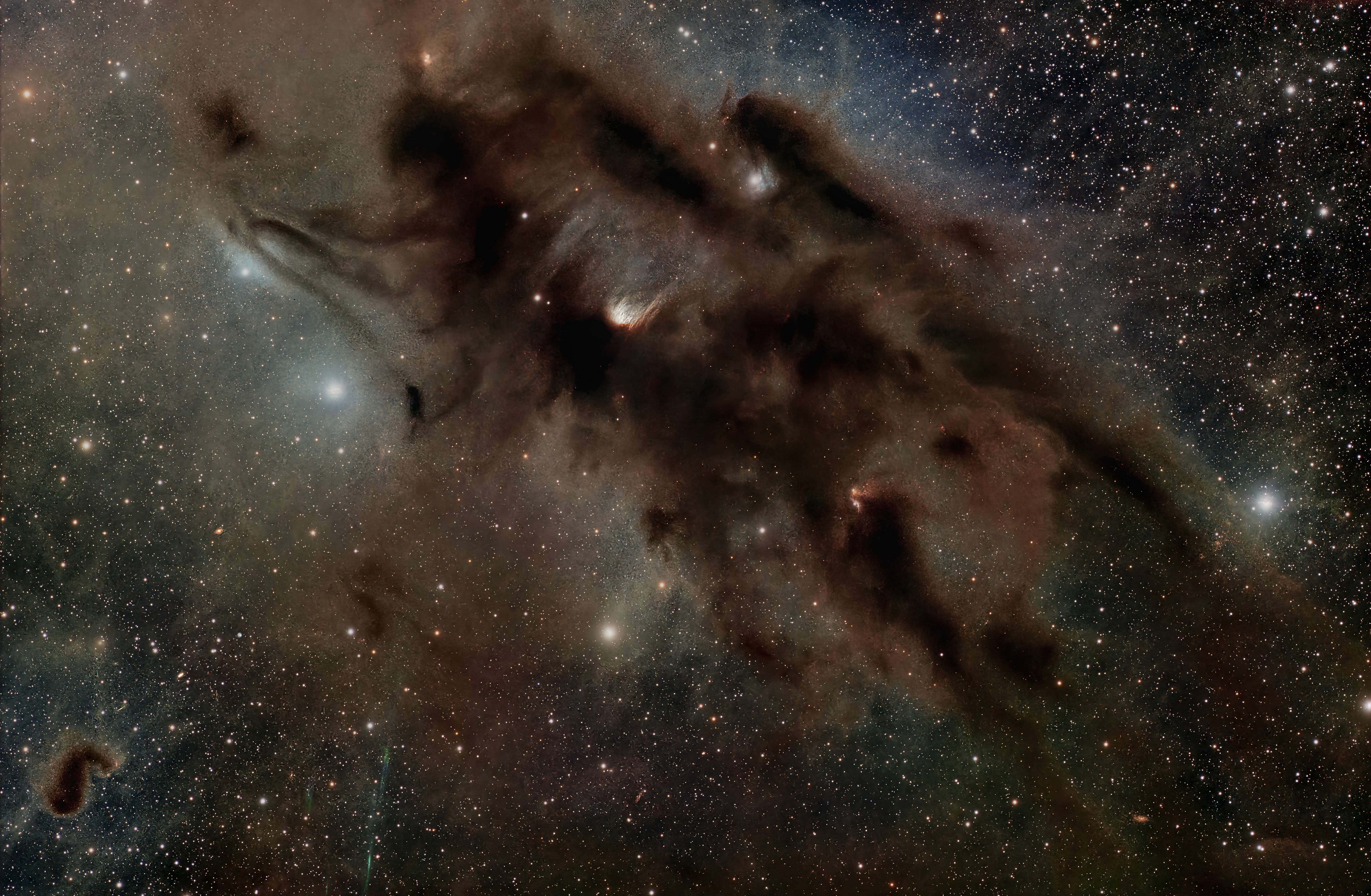
IBarnard 150
(b150) This is a dark nebula located in the constellation Cepheus. Cepheus was the king of Aethiopia and husband of Queen Cassiopeia, and father of Andromeda. It is about 1200 light-years away from us. Although this is a dark nebula, star making regions have still been found inside the nebula. Image processed by Ron Yelton. Original data from Telescope Live |
|
Location:
El Sauce Observatory, Chile
Date: November 2023 Mount: Mathis MI-1000/1250 Telescope: Planewave CDK24 (CHI-1) Camera: QHY600m @-25c Exposure: 167 x 5 min for LRGB. Total: 13 hrs 55 min |
Location: Spain Date: December 9, 2023 Mount: Unknown Telescope:ZWO_ASI_2600mm Pro (T-16) Camera: ZWO_ASI_2600mm Exposure: 220 x 600s LRGB. Total 24 hrs 20 min. |
Location: IC Astronomy Observatory, Spain
Date: April - May 2022 Mount: ASA Alt-Az Telescope: ASA RC-1000AZ (CHI-3 CCD) Camera: FLI PL16803 Exposure: 64 x 10 min LRGB Total: 10 hrs 40 min |
 |
 |
 |
|
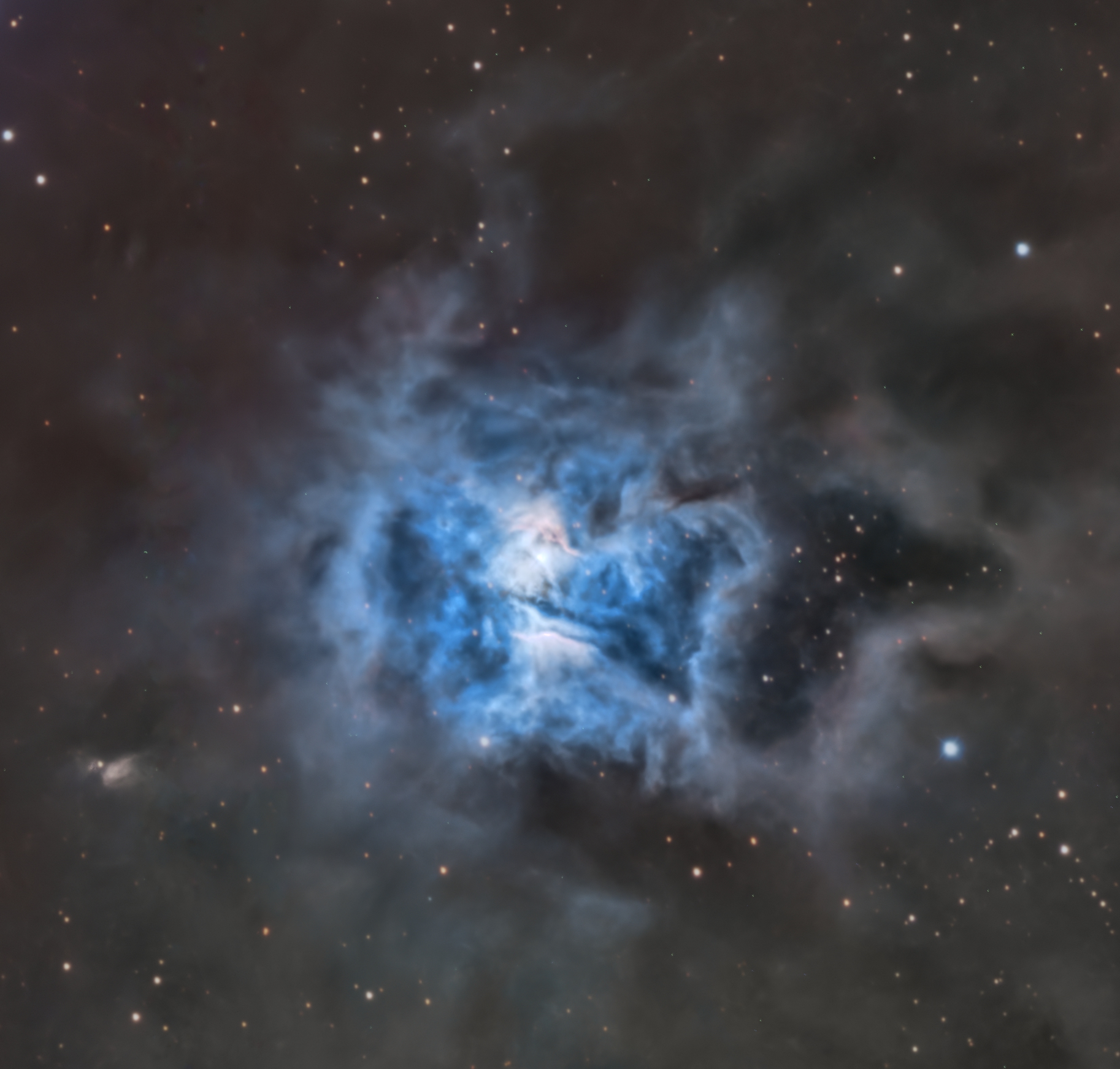
NGC 7023 - The Iris Nebula Out in the constellation Cepheus, about 1300 light-years away, lies the Iris Nebula. It is a bright reflection nebula with a width of 6 light-years across. There is an open cluster embedded in the middle of the nebula designated NGC 7023. That nebula itself is designated as LBN 487 (Lynd;s Bright Nebulae Catalog) |
|
Location: IC
Astronomy Observatory, Spain
Date: March - April 2022 Mount: Officina Stellare EQ Mount Telescope: Officina Stellare Pro RC 700 (27" f/8) (SPA-2) Camera: FLI PL16803 23' x 23' @-25c Exposure: 16 x 10 min each LRGB Total: 2 hrs 40 min |
 |
Except as noted all images Copyright by Ron Yelton and may not be used without permission.